import torch
import torch.nn as nn1 Introduction to PyTorch: Fully Connected Neural Networks
1.1 Introduction
In this first module, we will dive into PyTorch by building a simple, fully connected neural network. The primary learning objectives are to:
Learn how to subclass the nn.Module class to define a neural network architecture
Set up the
__init__()constructor method and define a forward passUse
nn.Sequential()to simplify your neural network definition
Although this example is pretty simple, you will see that more complex neural network architectures can be defined using the same workflow. We will do so in later modules.
1.2 Setup
First, we need to import the required packages.
Importing torch allows us to use PyTorch and the associated methods and classes. Among other functions, PyTorch allows us to define tensors and neural network architectures.
Importing torch.nn from torch allows us to use classes and functions from this subpackage without adding the torch prefix. This is a common shorthand when using PyTorch.
PyTorch allows for computation to be performed on central processing units (CPUs) or graphics processing units (GPUs). Although it is not required for this module since we will not be training a model or using a trained model to make inferences, below I am showing how to check whether or not you have access to a GPU. If a GPU is available for computation, it gets assigned to the device variable. If not, then “cpu” gets assigned to the device variable. You can then input the device variable when moving models and/or data to a specific device for computation.
device = torch.device("cuda:0" if torch.cuda.is_available() else "cpu")
print(device)cuda:01.3 Define Network Architecture
We are now ready to build a neural network. A fully connected neural network is defined below. I am creating a neural network called myFCN by subclassing the nn.Module class made available by PyTorch. Within the __init__() constructor method and in order to inherit from the parent or super class, I define super().__init__(). I then define new parameters within the constructor method. Specifically, users should be able to specify the size of the input 1D array (inSize), the sizes of the outputs of each hidden layer (hiddenSizes), and the number of output nodes (outSize). For a classification problem, the output size would need to be equal to the number of classes. For a binary classification, the output size can be 1 or 2. We will discuss this in more detail in later modules. For a regression problem, the output size will be 1.
The general structure of a fully connected artificial neural network (ANN) is shown in Figure 1.1. The input values, such as the predictor variables for a sample, are passed to one or more hidden layers, which are in turn connected to an output layer that generates the predictions. Each circle represents a neuron or node, and each line represents a connection between neurons in adjacent layers. The network is described as fully connected because every neuron in a layer is connected to every neuron in the next layer.
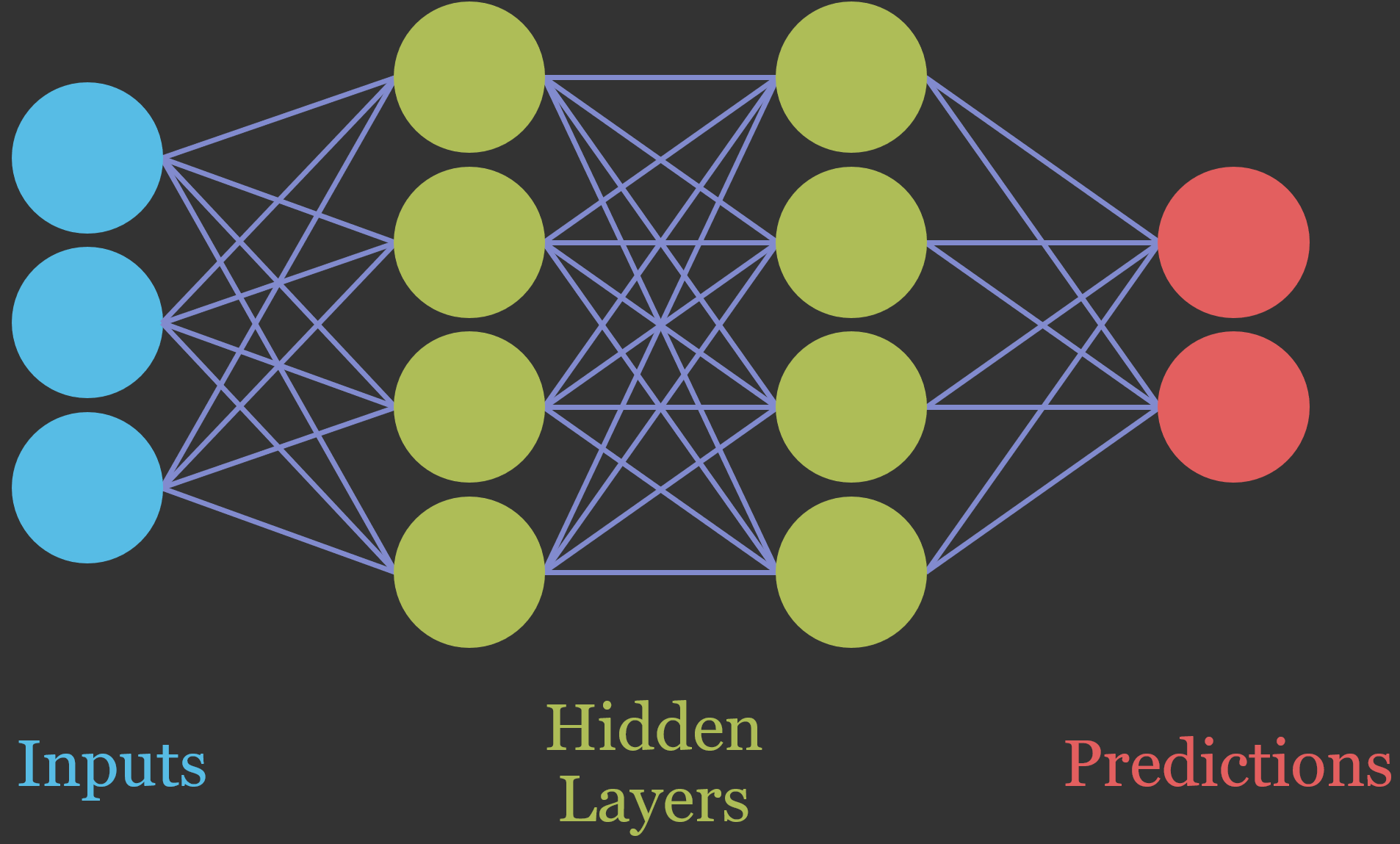
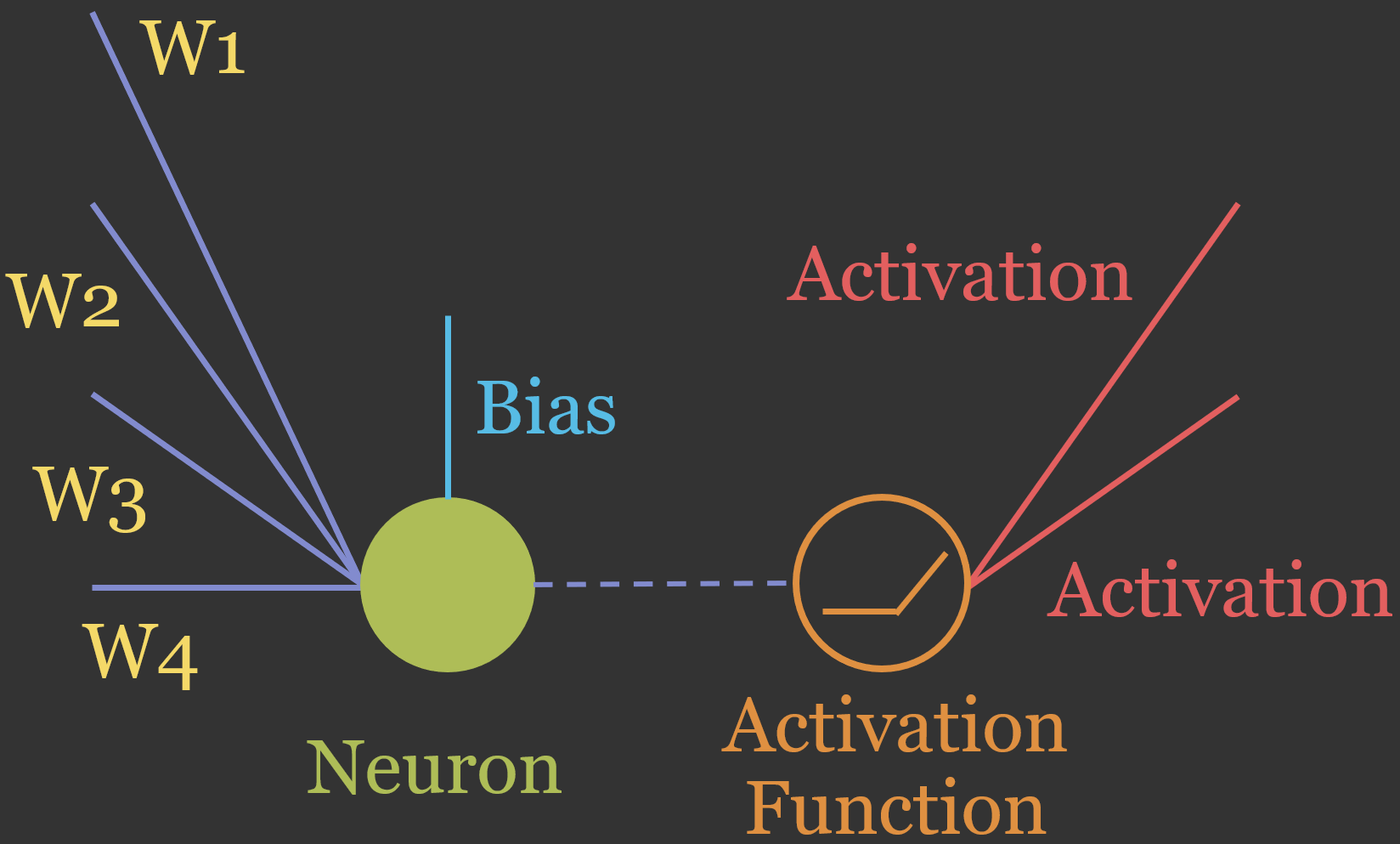
Figure 1.2 shows the operations performed by a single neuron. Each input to the neuron is multiplied by an associated weight (W1 through W4), the weighted inputs are summed, and a bias term is added. The result is then passed through an activation function, and the output, or activation, is passed to each neuron in the next layer. The weights and biases are the trainable parameters that are learned during the training process.
Next, I define the layers that will make up the neural network. This network will consist of the following process:
Input –> Fully Connected Layer –> Batch Normalization –> Rectified Linear Unit Activation –> Batch Normalization –> Rectified Linear Unit Activation –> Fully Connected Layer
To implement this, I must define the fully connected layers, the batch normalization layers, and a rectified linear unit activation (ReLU) function. nn.Linear() allows for defining a fully connected layer with a define input and output size. The input size needs to be the output size from the previous layer while the output size represents the number of neurons or nodes in the current layer. So, the first fully connected layer will accept an input size equal to the size of the input data. The second fully connected layer will accept an input size equal to the size of the first fully connected layer, and the last fully connected layer requires an input size equal to the output of the second hidden layer. For the last fully connected layer, the output size would need to be set to the number of classes for a classification problem or 1 for a regression problem.
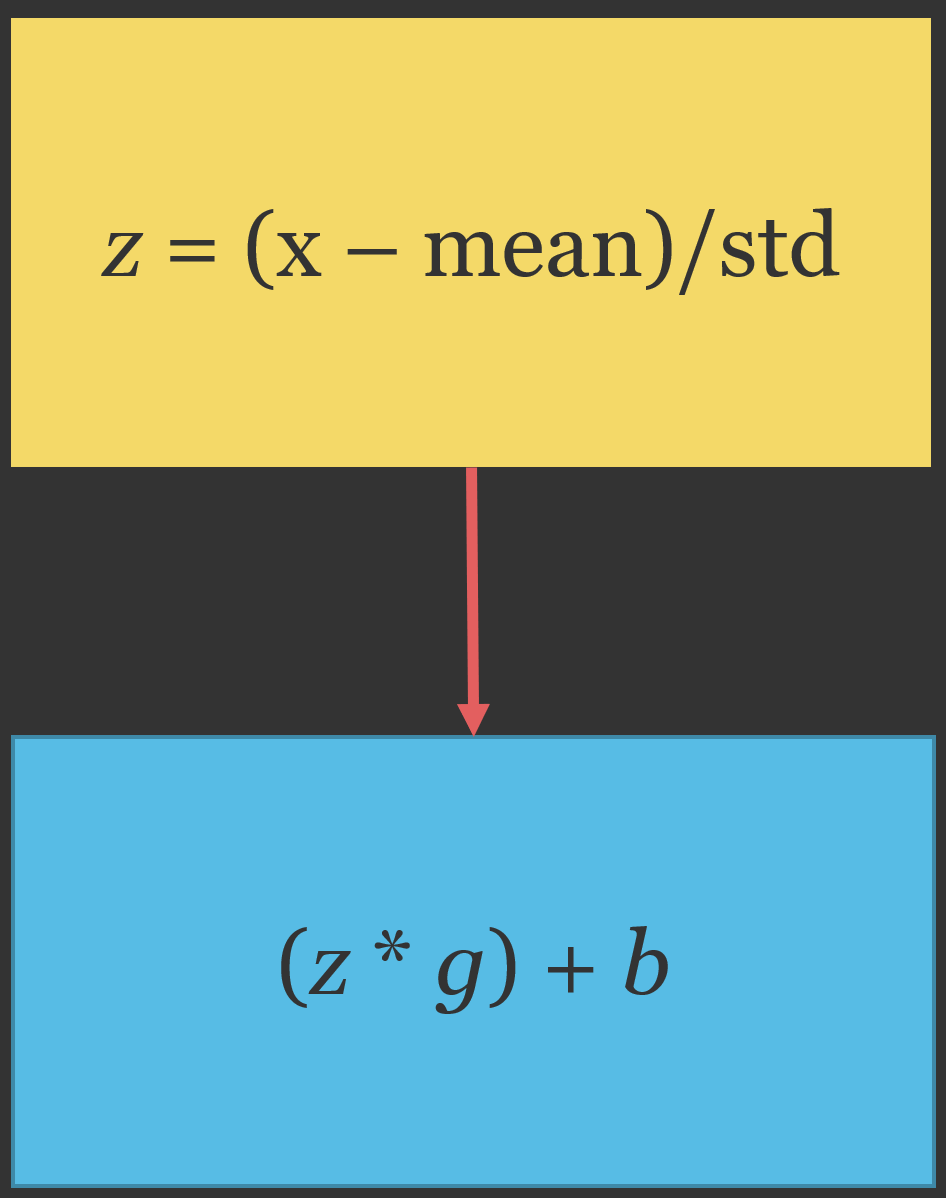
Batch normalization is conceptualized in Figure 1.3. For each mini-batch of samples, the outputs of each neuron, or each channel for the 2D batch normalization used in convolutional neural networks, are standardized to z-scores by subtracting the mean and dividing by the standard deviation calculated from the mini-batch. The standardized values are then scaled by a learnable weight (g) and shifted by a learnable bias (b), so the network can learn the most useful distribution for the values passed to the next layer. Batch normalization generally stabilizes and speeds up training. During inference, running estimates of the mean and standard deviation calculated during training are used instead of the mini-batch statistics.
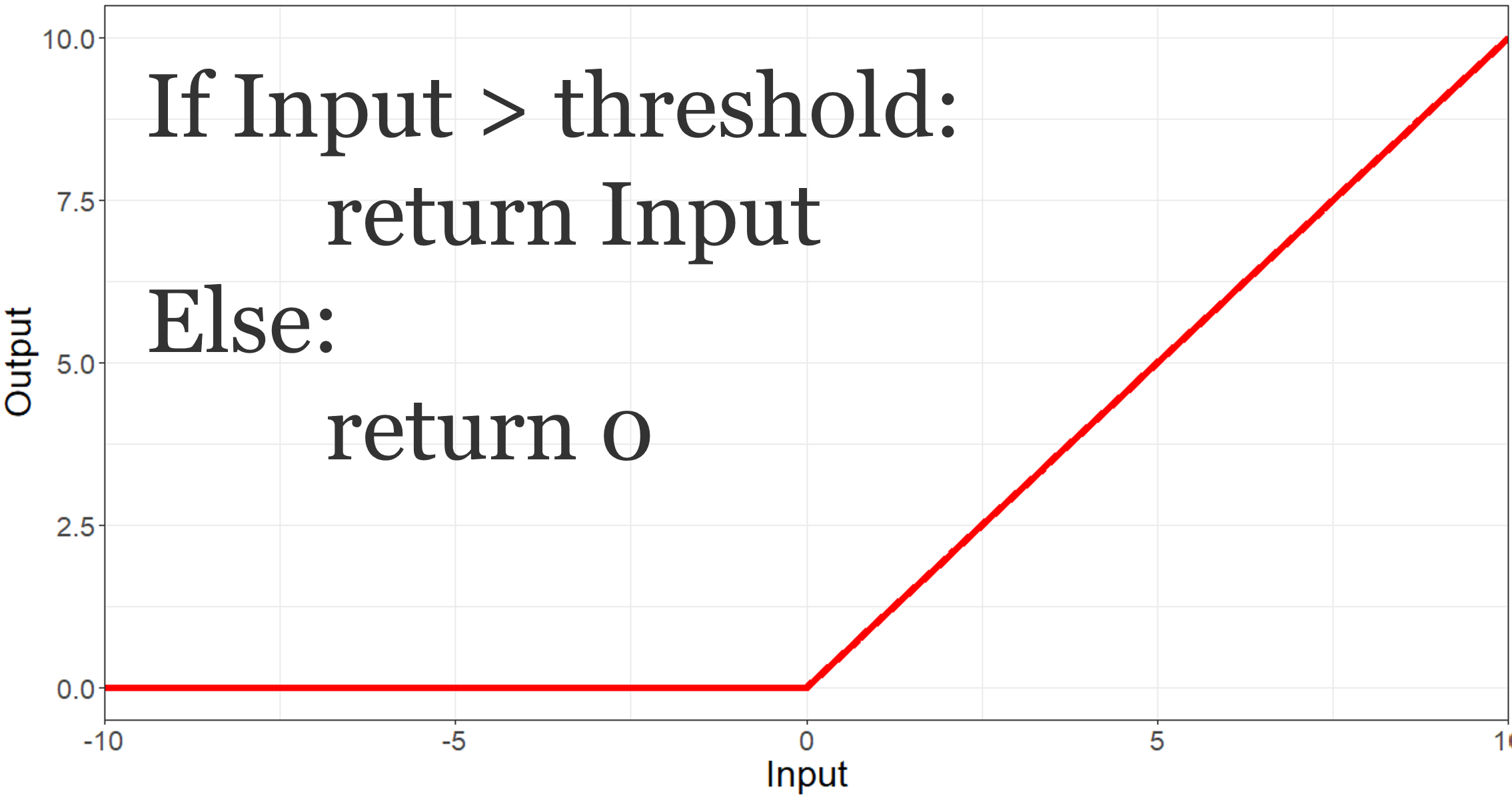
The ReLU activation function is shown in Figure 1.4. If the input is greater than 0, the input is returned unchanged; otherwise, 0 is returned. Activation functions introduce non-linearity into the network. Without them, a sequence of fully connected layers would simplify to a single linear transformation of the inputs regardless of the number of layers. ReLU is simple and fast to compute, and, since its gradient is 1 for all positive inputs, it is less susceptible to the vanishing gradient problem than activation functions such as the sigmoid function. We will explore alternative activation functions in Chapter 7.
Batch normalization and an activation function are not applied following the last fully connected layer. This is because I want to obtain the logits. Logits can be converted to probabilities using a sigmoid function, in the case of a binary classification with one output node, or a softmax activation for a multiclass classification. Whether or not you want to convert the raw logits to probabilities will depend on what is expected by the loss metric being used. We will explore this in later modules. For now, we will just output the raw logits.
The __init__() constructor method is used to define the parameters associated with the subclass and the components of the model. It does not specify how data will be fed through the network. This is the purpose of the forward() method. The forward method accepts an input (x), which is then passed through the network sequentially. It then returns the result of the network, which in this case is saved to the variable x.
If you are having trouble following the syntax, you may need to review how classes and subclassing is implemented with Python. For example, if you are confused by the use of the self variable, there is a good chance that you need to further investigate classes.
class myFCN(nn.Module):
  def __init__(self, inSize, hiddenSizes, outSize):
    super().__init__()
    self.inSize = inSize
    self.hiddenSize = hiddenSizes
    self.outSize = outSize

    self.lin1 = nn.Linear(inSize, hiddenSizes[0])
    self.lin2 = nn.Linear(hiddenSizes[0], hiddenSizes[1])
    self.lin3 = nn.Linear(hiddenSizes[1], outSize)

    self.bn1 = nn.BatchNorm2d(hiddenSizes[0])
    self.bn2 = nn.BatchNorm2d(hiddenSizes[1])

    self.relu = nn.ReLU()

  def forward(self, x):
    x = self.relu(self.bn1(self.lin1(x)))
    x = self.relu(self.bn2(self.lin2(x)))
    x = self.lin3(x)
    return x
Running the code above creates the subclass from the nn.Module class that inherits the functionality of nn.Module and implements the neural network defined. To instantiate an instance of my new myFCN subclass, I call the class name and provide arguments to the required parameters. Below, I am instantiating an instance of the myFCN nn.Module subclass called model. The defined neural network accepts 10 inputs, has 2 intermediate layers with 256 nodes each, and has a final fully connected layer with 5 nodes, mimicking a classification problem where five classes are differentiated.
Note the use of the to() method, which allows me to move the model to the device, in my case a GPU.
By simply calling the model, its contents will be printed.
model = myFCN(inSize=10, hiddenSizes=[256, 256], outSize=5).to(device)modelmyFCN(
(lin1): Linear(in_features=10, out_features=256, bias=True)
(lin2): Linear(in_features=256, out_features=256, bias=True)
(lin3): Linear(in_features=256, out_features=5, bias=True)
(bn1): BatchNorm2d(256, eps=1e-05, momentum=0.1, affine=True, bias=True, track_running_stats=True)
(bn2): BatchNorm2d(256, eps=1e-05, momentum=0.1, affine=True, bias=True, track_running_stats=True)
(relu): ReLU()
)1.4 Using nn.Sequential()
Another means to define a neural network architecture is to use nn.Sequential(), which allows you to define a sequence of operations. This is specifically useful when data pass through a network sequentially or linearly.
Below, I have constructed the same network as defined above, but now using nn.Sequential(). All components of the network are now combined within the theNetwork object. Using nn.Sequential() greatly simplifies the forward method. In this case, the input (x) is simply provided to theNetwork and the result is returned.
Either of these methods will yield the same resulting network. Whether or not you want to use nn.Sequential() is generally just personal preference. However, it can simplify defining networks, especially for more complex networks. I generally prefer using nn.Sequential() as I find the code easier to read, especially as networks become larger and more complicated.
Below, I have instantiated the network again using the new definition. Note that using nn.Sequential() does change the printed summary when the model name is called.
class myFCN(nn.Module):
  def __init__(self, inSize, hiddenSizes, outSize):
    super().__init__()
    self.inSize = inSize
    self.hiddenSize = hiddenSizes
    self.outSize = outSize

    self.theNetwork = nn.Sequential(
        nn.Linear(inSize, hiddenSizes[0]),
        nn.BatchNorm1d(hiddenSizes[0]),
        nn.ReLU(inplace=True),
        nn.Linear(hiddenSizes[0], hiddenSizes[1]),
        nn.BatchNorm1d(hiddenSizes[1]),
        nn.ReLU(inplace=True),
        nn.Linear(hiddenSizes[1], outSize)
    )

  def forward(self, x):
    x = self.theNetwork(x)
    return x
model = myFCN(inSize=6, hiddenSizes=[256, 256], outSize=10).to(device)modelmyFCN(
(theNetwork): Sequential(
(0): Linear(in_features=6, out_features=256, bias=True)
(1): BatchNorm1d(256, eps=1e-05, momentum=0.1, affine=True, bias=True, track_running_stats=True)
(2): ReLU(inplace=True)
(3): Linear(in_features=256, out_features=256, bias=True)
(4): BatchNorm1d(256, eps=1e-05, momentum=0.1, affine=True, bias=True, track_running_stats=True)
(5): ReLU(inplace=True)
(6): Linear(in_features=256, out_features=10, bias=True)
)
)1.5 Concluding Remarks
We now have a very simple network defined, but there is much more to do. We need to read in data, prepare it as input to the neural network, define a loss metric, define some assessment metrics, set up a training loop, train the model, assess the model, and use it to make predictions. We will cover all of these topics in later modules. In the next module, we will first explore tensors and tensor operations in more detail.
1.6 Questions
- Explain the purpose of the
__init__()constructor method and theforward()method when defining a neural network architecture by subclassingnn.Module. - Why is
super().__init__()called within the constructor method of annn.Modulesubclass? - When defining a series of fully connected layers using
nn.Linear(), how must the input and output sizes of consecutive layers relate to each other? What determines the input size of the first layer and the output size of the last layer? - How many output nodes are required in the final fully connected layer for (1) a regression problem, (2) a binary classification problem, and (3) a multiclass classification problem in which eight classes are differentiated?
- Why are batch normalization and an activation function not applied after the final fully connected layer in the architectures defined in this chapter?
- Explain the difference between a class logit and a class probability. What functions are used to convert logits to probabilities for binary and multiclass classification problems?
- Compare defining an architecture by calling each layer within the
forward()method to defining it usingnn.Sequential(). In what situations would a singlenn.Sequential()call not be sufficient to define an entire architecture? - What is the purpose of the
devicevariable and theto()method? Why must a model and the data provided to it be on the same device?