import torch
import torch.nn as nn

from torchinfo import summary

import torchvision
from torchvision import transforms

from PIL import Image

import matplotlib.pyplot as plt

import numpy as np
import pandas as pd12 Convolutional Neural Network Architectures
12.1 Introduction
We will now explore some common CNN architectures as implemented in torchvision. This package adds functionality to the PyTorch ecosystem focused on working with images and video data. This package provides tools for loading images, defining image DataSets, and loading built-in datasets. As you will see in this section, it also provides access to common CNN architectures and associated pre-trained weights. Other than just scene labeling or classification tasks, there are also tools and datasets specific to semantic segmentation, object detection, and instance segmentation.
In this chapter, we will specifically explore the VGGNet and ResNet architectures and an efficient architecture, MobileNetV2. We will not discuss these architectures in detail; instead, we will focus on how to implement them using torchvision. For a more conceptual discussion, see the texts recommended in the Preface. The examples here will translate well to other architectures made available through torchvision. In the next chapter, we will bring together what you have learned throughout the CNN chapters to use transfer learning and a modified ResNet-34 architecture to classify the EuroSatAllBands dataset.
I begin by importing the needed packages. In this module, I will use the Python Imaging Library (PIL) to read in images. I am using this package because it works well with torchvision. I also set the device variable to the GPU if available.
device = torch.device("cuda:0" if torch.cuda.is_available() else "cpu")
print(device)cuda:012.2 VGGNet-16
Models are available in the torchvision.models subpackage. More information about this subpackage can be found here: https://pytorch.org/vision/stable/models.html. As a first example, I am instantiating an instance of the VGGNet-16 architecture. I also move the model to the GPU using the to() method. The weights parameter is used to load in pre-trained weights: weights="DEFAULT" loads the best available ImageNet weights for the architecture, while weights=None initializes the parameters randomly. Older versions of torchvision used a pretrained parameter for this purpose, which is now deprecated. Pre-trained weights allow you to either (1) use the pre-trained model to predict to new data or (2) instantiate an instance of the model using the pre-trained weights as opposed to random weights that can then be fine-tuned on new data. If you load pre-trained weights, they will be downloaded to your local device or your Google Drive if you are working in CoLab.
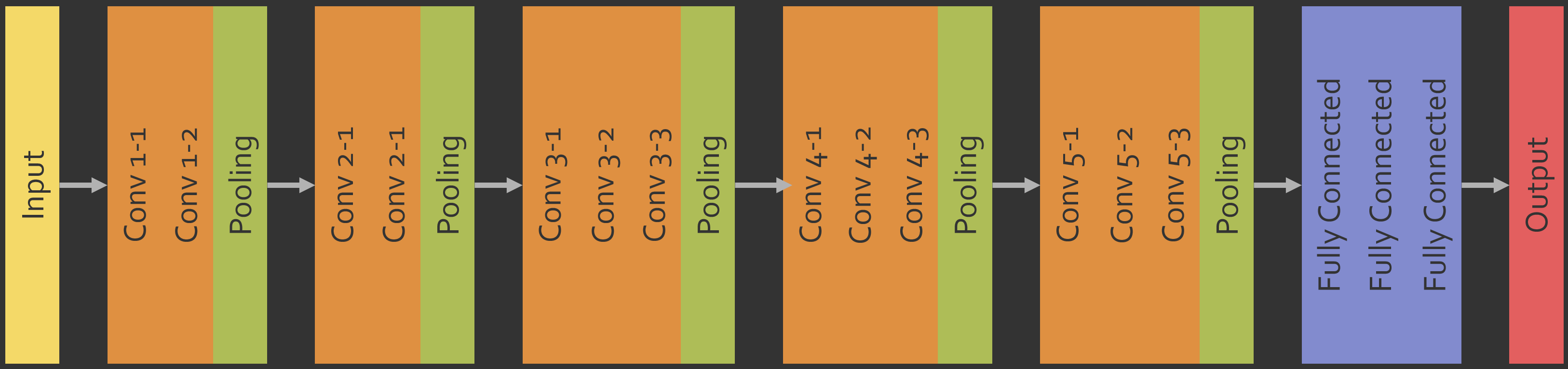
The VGGNet-16 architecture is conceptualized in Figure 12.1. It consists of five convolutional blocks, each containing two or three 3x3 convolutional layers followed by a max pooling layer that halves the height and width of the feature maps. The 13 convolutional layers are followed by three fully connected layers, which give the architecture its 16 layers with trainable parameters. VGGNet demonstrated that a deep network built from a simple, repeated pattern of small 3x3 kernels can perform well. Most of its parameters are in the fully connected layers.
modelVGG = torchvision.models.vgg16(weights="DEFAULT").to(device)I next use the summary function from torchinfo to print a summary of the model if a mini-batch with a shape of (12,3,256,256) is passed through the network. This is a fairly large model with 138,357,544 trainable parameters and an estimated total size of 814 MB. Again, we will not discuss the components of this architecture here.
summary(modelVGG, (12, 3, 256, 256))==========================================================================================
Layer (type:depth-idx) Output Shape Param #
==========================================================================================
VGG [12, 1000] --
├─Sequential: 1-1 [12, 512, 8, 8] --
│ └─Conv2d: 2-1 [12, 64, 256, 256] 1,792
│ └─ReLU: 2-2 [12, 64, 256, 256] --
│ └─Conv2d: 2-3 [12, 64, 256, 256] 36,928
│ └─ReLU: 2-4 [12, 64, 256, 256] --
│ └─MaxPool2d: 2-5 [12, 64, 128, 128] --
│ └─Conv2d: 2-6 [12, 128, 128, 128] 73,856
│ └─ReLU: 2-7 [12, 128, 128, 128] --
│ └─Conv2d: 2-8 [12, 128, 128, 128] 147,584
│ └─ReLU: 2-9 [12, 128, 128, 128] --
│ └─MaxPool2d: 2-10 [12, 128, 64, 64] --
│ └─Conv2d: 2-11 [12, 256, 64, 64] 295,168
│ └─ReLU: 2-12 [12, 256, 64, 64] --
│ └─Conv2d: 2-13 [12, 256, 64, 64] 590,080
│ └─ReLU: 2-14 [12, 256, 64, 64] --
│ └─Conv2d: 2-15 [12, 256, 64, 64] 590,080
│ └─ReLU: 2-16 [12, 256, 64, 64] --
│ └─MaxPool2d: 2-17 [12, 256, 32, 32] --
│ └─Conv2d: 2-18 [12, 512, 32, 32] 1,180,160
│ └─ReLU: 2-19 [12, 512, 32, 32] --
│ └─Conv2d: 2-20 [12, 512, 32, 32] 2,359,808
│ └─ReLU: 2-21 [12, 512, 32, 32] --
│ └─Conv2d: 2-22 [12, 512, 32, 32] 2,359,808
│ └─ReLU: 2-23 [12, 512, 32, 32] --
│ └─MaxPool2d: 2-24 [12, 512, 16, 16] --
│ └─Conv2d: 2-25 [12, 512, 16, 16] 2,359,808
│ └─ReLU: 2-26 [12, 512, 16, 16] --
│ └─Conv2d: 2-27 [12, 512, 16, 16] 2,359,808
│ └─ReLU: 2-28 [12, 512, 16, 16] --
│ └─Conv2d: 2-29 [12, 512, 16, 16] 2,359,808
│ └─ReLU: 2-30 [12, 512, 16, 16] --
│ └─MaxPool2d: 2-31 [12, 512, 8, 8] --
├─AdaptiveAvgPool2d: 1-2 [12, 512, 7, 7] --
├─Sequential: 1-3 [12, 1000] --
│ └─Linear: 2-32 [12, 4096] 102,764,544
│ └─ReLU: 2-33 [12, 4096] --
│ └─Dropout: 2-34 [12, 4096] --
│ └─Linear: 2-35 [12, 4096] 16,781,312
│ └─ReLU: 2-36 [12, 4096] --
│ └─Dropout: 2-37 [12, 4096] --
│ └─Linear: 2-38 [12, 1000] 4,097,000
==========================================================================================
Total params: 138,357,544
Trainable params: 138,357,544
Non-trainable params: 0
Total mult-adds (Units.GIGABYTES): 242.23
==========================================================================================
Input size (MB): 9.44
Forward/backward pass size (MB): 1699.58
Params size (MB): 553.43
Estimated Total Size (MB): 2262.44
==========================================================================================There are sometimes different flavors or implementations of the same model available. In the example below, I have created an instance of the VGGNet-16 architecture that incorporates batch normalization using the vgg16_bn() function. Printing the summary, you can see that the model now includes batch normalization layers. This also increases the required memory size of the model and the number of trainable parameters.
modelVGG = torchvision.models.vgg16_bn(weights="DEFAULT").to(device)summary(modelVGG, (12, 3, 256, 256))==========================================================================================
Layer (type:depth-idx) Output Shape Param #
==========================================================================================
VGG [12, 1000] --
├─Sequential: 1-1 [12, 512, 8, 8] --
│ └─Conv2d: 2-1 [12, 64, 256, 256] 1,792
│ └─BatchNorm2d: 2-2 [12, 64, 256, 256] 128
│ └─ReLU: 2-3 [12, 64, 256, 256] --
│ └─Conv2d: 2-4 [12, 64, 256, 256] 36,928
│ └─BatchNorm2d: 2-5 [12, 64, 256, 256] 128
│ └─ReLU: 2-6 [12, 64, 256, 256] --
│ └─MaxPool2d: 2-7 [12, 64, 128, 128] --
│ └─Conv2d: 2-8 [12, 128, 128, 128] 73,856
│ └─BatchNorm2d: 2-9 [12, 128, 128, 128] 256
│ └─ReLU: 2-10 [12, 128, 128, 128] --
│ └─Conv2d: 2-11 [12, 128, 128, 128] 147,584
│ └─BatchNorm2d: 2-12 [12, 128, 128, 128] 256
│ └─ReLU: 2-13 [12, 128, 128, 128] --
│ └─MaxPool2d: 2-14 [12, 128, 64, 64] --
│ └─Conv2d: 2-15 [12, 256, 64, 64] 295,168
│ └─BatchNorm2d: 2-16 [12, 256, 64, 64] 512
│ └─ReLU: 2-17 [12, 256, 64, 64] --
│ └─Conv2d: 2-18 [12, 256, 64, 64] 590,080
│ └─BatchNorm2d: 2-19 [12, 256, 64, 64] 512
│ └─ReLU: 2-20 [12, 256, 64, 64] --
│ └─Conv2d: 2-21 [12, 256, 64, 64] 590,080
│ └─BatchNorm2d: 2-22 [12, 256, 64, 64] 512
│ └─ReLU: 2-23 [12, 256, 64, 64] --
│ └─MaxPool2d: 2-24 [12, 256, 32, 32] --
│ └─Conv2d: 2-25 [12, 512, 32, 32] 1,180,160
│ └─BatchNorm2d: 2-26 [12, 512, 32, 32] 1,024
│ └─ReLU: 2-27 [12, 512, 32, 32] --
│ └─Conv2d: 2-28 [12, 512, 32, 32] 2,359,808
│ └─BatchNorm2d: 2-29 [12, 512, 32, 32] 1,024
│ └─ReLU: 2-30 [12, 512, 32, 32] --
│ └─Conv2d: 2-31 [12, 512, 32, 32] 2,359,808
│ └─BatchNorm2d: 2-32 [12, 512, 32, 32] 1,024
│ └─ReLU: 2-33 [12, 512, 32, 32] --
│ └─MaxPool2d: 2-34 [12, 512, 16, 16] --
│ └─Conv2d: 2-35 [12, 512, 16, 16] 2,359,808
│ └─BatchNorm2d: 2-36 [12, 512, 16, 16] 1,024
│ └─ReLU: 2-37 [12, 512, 16, 16] --
│ └─Conv2d: 2-38 [12, 512, 16, 16] 2,359,808
│ └─BatchNorm2d: 2-39 [12, 512, 16, 16] 1,024
│ └─ReLU: 2-40 [12, 512, 16, 16] --
│ └─Conv2d: 2-41 [12, 512, 16, 16] 2,359,808
│ └─BatchNorm2d: 2-42 [12, 512, 16, 16] 1,024
│ └─ReLU: 2-43 [12, 512, 16, 16] --
│ └─MaxPool2d: 2-44 [12, 512, 8, 8] --
├─AdaptiveAvgPool2d: 1-2 [12, 512, 7, 7] --
├─Sequential: 1-3 [12, 1000] --
│ └─Linear: 2-45 [12, 4096] 102,764,544
│ └─ReLU: 2-46 [12, 4096] --
│ └─Dropout: 2-47 [12, 4096] --
│ └─Linear: 2-48 [12, 4096] 16,781,312
│ └─ReLU: 2-49 [12, 4096] --
│ └─Dropout: 2-50 [12, 4096] --
│ └─Linear: 2-51 [12, 1000] 4,097,000
==========================================================================================
Total params: 138,365,992
Trainable params: 138,365,992
Non-trainable params: 0
Total mult-adds (Units.GIGABYTES): 242.23
==========================================================================================
Input size (MB): 9.44
Forward/backward pass size (MB): 3398.27
Params size (MB): 553.46
Estimated Total Size (MB): 3961.17
==========================================================================================12.3 ResNet
Similar to the VGGNet-16 examples, ResNet models are also made available through torchvision with pre-trained weights from ImageNet. Below, I am instantiating an instance of the ResNet-34 architecture with pre-trained weights. Many models have an expected number of channels and height and width of provided images. So, it is common to need to perform pre-processing, as you will see below. This ResNet architecture expects 3-band, RGB images with spatial dimensions of 224x224. In contrast, the VGGNet-16 architecture above expects spatial dimensions of 256x256.
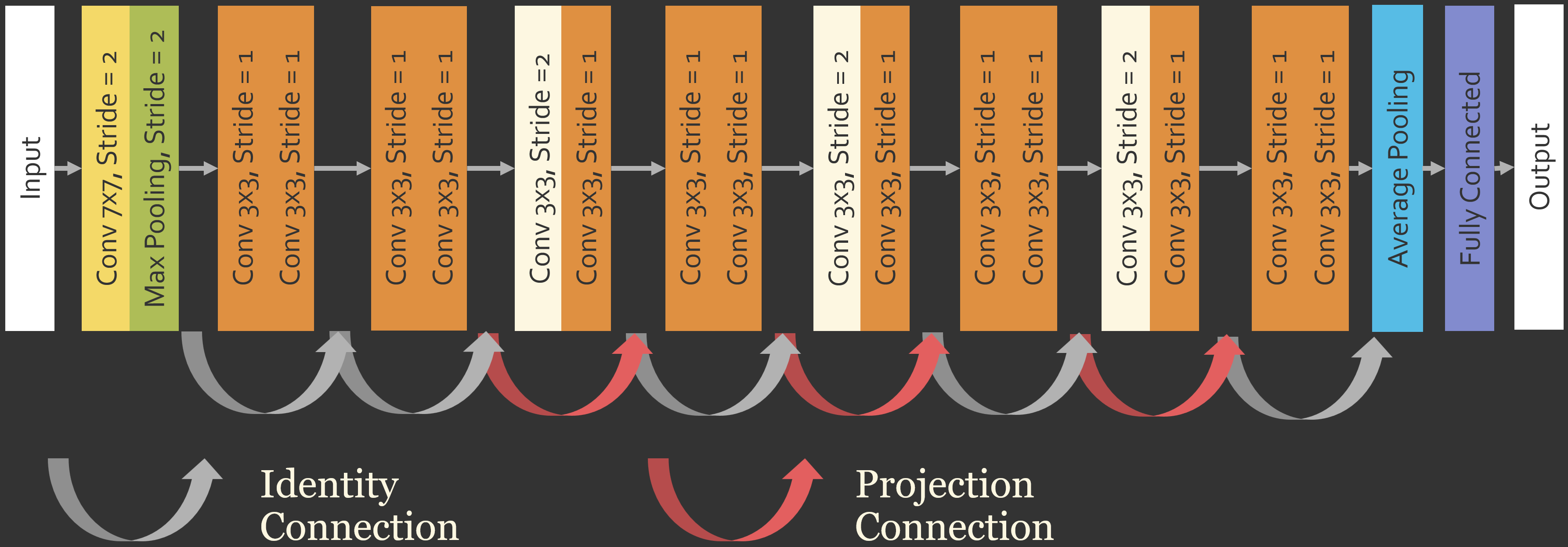
The ResNet-18 architecture is conceptualized in Figure 12.2. ResNet-34, which is used here, follows the same structure but with more blocks in each stage. The input is first processed by a 7x7 convolution and max pooling, each with a stride of 2. The data are then passed through a series of residual blocks, each containing two 3x3 convolutional layers. Instead of max pooling, the spatial dimensions are halved by using a stride of 2 in the first convolution of the first block in each stage after the first. The final feature maps are summarized using global average pooling and passed to a single fully connected layer.
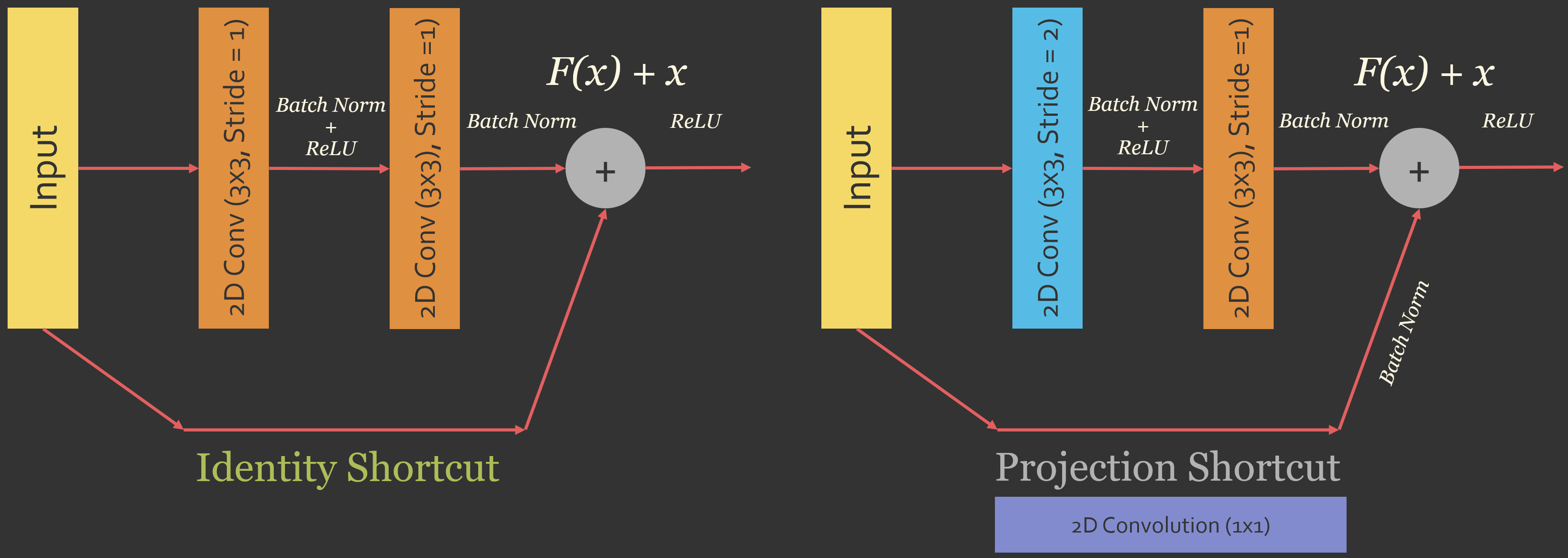
The defining feature of ResNet is the residual connection, or skip connection, conceptualized in Figure 12.3. The input to a block (x) is added to the output of the block’s convolutional layers (F(x)), so the block only needs to learn the residual, or the difference from its input. Residual connections allow gradients to flow directly to earlier layers during backpropagation, which makes very deep networks easier to train. When the input and output of a block have the same shape, the input is added directly using an identity connection. When the first convolution in a block has a stride of 2 and increases the number of channels, the input is passed through a 1x1 convolution with a stride of 2, followed by batch normalization, so that it has the same shape as the block’s output. This is called a projection connection.
Printing a summary for the model, you can see that the ResNet-34 architecture has fewer overall parameters and trainable parameters in comparison to VGGNet-16.
modelRN34 = torchvision.models.resnet34(weights="DEFAULT").to(device)summary(modelRN34, (12, 3, 224, 224))==========================================================================================
Layer (type:depth-idx) Output Shape Param #
==========================================================================================
ResNet [12, 1000] --
├─Conv2d: 1-1 [12, 64, 112, 112] 9,408
├─BatchNorm2d: 1-2 [12, 64, 112, 112] 128
├─ReLU: 1-3 [12, 64, 112, 112] --
├─MaxPool2d: 1-4 [12, 64, 56, 56] --
├─Sequential: 1-5 [12, 64, 56, 56] --
│ └─BasicBlock: 2-1 [12, 64, 56, 56] --
│ │ └─Conv2d: 3-1 [12, 64, 56, 56] 36,864
│ │ └─BatchNorm2d: 3-2 [12, 64, 56, 56] 128
│ │ └─ReLU: 3-3 [12, 64, 56, 56] --
│ │ └─Conv2d: 3-4 [12, 64, 56, 56] 36,864
│ │ └─BatchNorm2d: 3-5 [12, 64, 56, 56] 128
│ │ └─ReLU: 3-6 [12, 64, 56, 56] --
│ └─BasicBlock: 2-2 [12, 64, 56, 56] --
│ │ └─Conv2d: 3-7 [12, 64, 56, 56] 36,864
│ │ └─BatchNorm2d: 3-8 [12, 64, 56, 56] 128
│ │ └─ReLU: 3-9 [12, 64, 56, 56] --
│ │ └─Conv2d: 3-10 [12, 64, 56, 56] 36,864
│ │ └─BatchNorm2d: 3-11 [12, 64, 56, 56] 128
│ │ └─ReLU: 3-12 [12, 64, 56, 56] --
│ └─BasicBlock: 2-3 [12, 64, 56, 56] --
│ │ └─Conv2d: 3-13 [12, 64, 56, 56] 36,864
│ │ └─BatchNorm2d: 3-14 [12, 64, 56, 56] 128
│ │ └─ReLU: 3-15 [12, 64, 56, 56] --
│ │ └─Conv2d: 3-16 [12, 64, 56, 56] 36,864
│ │ └─BatchNorm2d: 3-17 [12, 64, 56, 56] 128
│ │ └─ReLU: 3-18 [12, 64, 56, 56] --
├─Sequential: 1-6 [12, 128, 28, 28] --
│ └─BasicBlock: 2-4 [12, 128, 28, 28] --
│ │ └─Conv2d: 3-19 [12, 128, 28, 28] 73,728
│ │ └─BatchNorm2d: 3-20 [12, 128, 28, 28] 256
│ │ └─ReLU: 3-21 [12, 128, 28, 28] --
│ │ └─Conv2d: 3-22 [12, 128, 28, 28] 147,456
│ │ └─BatchNorm2d: 3-23 [12, 128, 28, 28] 256
│ │ └─Sequential: 3-24 [12, 128, 28, 28] 8,448
│ │ └─ReLU: 3-25 [12, 128, 28, 28] --
│ └─BasicBlock: 2-5 [12, 128, 28, 28] --
│ │ └─Conv2d: 3-26 [12, 128, 28, 28] 147,456
│ │ └─BatchNorm2d: 3-27 [12, 128, 28, 28] 256
│ │ └─ReLU: 3-28 [12, 128, 28, 28] --
│ │ └─Conv2d: 3-29 [12, 128, 28, 28] 147,456
│ │ └─BatchNorm2d: 3-30 [12, 128, 28, 28] 256
│ │ └─ReLU: 3-31 [12, 128, 28, 28] --
│ └─BasicBlock: 2-6 [12, 128, 28, 28] --
│ │ └─Conv2d: 3-32 [12, 128, 28, 28] 147,456
│ │ └─BatchNorm2d: 3-33 [12, 128, 28, 28] 256
│ │ └─ReLU: 3-34 [12, 128, 28, 28] --
│ │ └─Conv2d: 3-35 [12, 128, 28, 28] 147,456
│ │ └─BatchNorm2d: 3-36 [12, 128, 28, 28] 256
│ │ └─ReLU: 3-37 [12, 128, 28, 28] --
│ └─BasicBlock: 2-7 [12, 128, 28, 28] --
│ │ └─Conv2d: 3-38 [12, 128, 28, 28] 147,456
│ │ └─BatchNorm2d: 3-39 [12, 128, 28, 28] 256
│ │ └─ReLU: 3-40 [12, 128, 28, 28] --
│ │ └─Conv2d: 3-41 [12, 128, 28, 28] 147,456
│ │ └─BatchNorm2d: 3-42 [12, 128, 28, 28] 256
│ │ └─ReLU: 3-43 [12, 128, 28, 28] --
├─Sequential: 1-7 [12, 256, 14, 14] --
│ └─BasicBlock: 2-8 [12, 256, 14, 14] --
│ │ └─Conv2d: 3-44 [12, 256, 14, 14] 294,912
│ │ └─BatchNorm2d: 3-45 [12, 256, 14, 14] 512
│ │ └─ReLU: 3-46 [12, 256, 14, 14] --
│ │ └─Conv2d: 3-47 [12, 256, 14, 14] 589,824
│ │ └─BatchNorm2d: 3-48 [12, 256, 14, 14] 512
│ │ └─Sequential: 3-49 [12, 256, 14, 14] 33,280
│ │ └─ReLU: 3-50 [12, 256, 14, 14] --
│ └─BasicBlock: 2-9 [12, 256, 14, 14] --
│ │ └─Conv2d: 3-51 [12, 256, 14, 14] 589,824
│ │ └─BatchNorm2d: 3-52 [12, 256, 14, 14] 512
│ │ └─ReLU: 3-53 [12, 256, 14, 14] --
│ │ └─Conv2d: 3-54 [12, 256, 14, 14] 589,824
│ │ └─BatchNorm2d: 3-55 [12, 256, 14, 14] 512
│ │ └─ReLU: 3-56 [12, 256, 14, 14] --
│ └─BasicBlock: 2-10 [12, 256, 14, 14] --
│ │ └─Conv2d: 3-57 [12, 256, 14, 14] 589,824
│ │ └─BatchNorm2d: 3-58 [12, 256, 14, 14] 512
│ │ └─ReLU: 3-59 [12, 256, 14, 14] --
│ │ └─Conv2d: 3-60 [12, 256, 14, 14] 589,824
│ │ └─BatchNorm2d: 3-61 [12, 256, 14, 14] 512
│ │ └─ReLU: 3-62 [12, 256, 14, 14] --
│ └─BasicBlock: 2-11 [12, 256, 14, 14] --
│ │ └─Conv2d: 3-63 [12, 256, 14, 14] 589,824
│ │ └─BatchNorm2d: 3-64 [12, 256, 14, 14] 512
│ │ └─ReLU: 3-65 [12, 256, 14, 14] --
│ │ └─Conv2d: 3-66 [12, 256, 14, 14] 589,824
│ │ └─BatchNorm2d: 3-67 [12, 256, 14, 14] 512
│ │ └─ReLU: 3-68 [12, 256, 14, 14] --
│ └─BasicBlock: 2-12 [12, 256, 14, 14] --
│ │ └─Conv2d: 3-69 [12, 256, 14, 14] 589,824
│ │ └─BatchNorm2d: 3-70 [12, 256, 14, 14] 512
│ │ └─ReLU: 3-71 [12, 256, 14, 14] --
│ │ └─Conv2d: 3-72 [12, 256, 14, 14] 589,824
│ │ └─BatchNorm2d: 3-73 [12, 256, 14, 14] 512
│ │ └─ReLU: 3-74 [12, 256, 14, 14] --
│ └─BasicBlock: 2-13 [12, 256, 14, 14] --
│ │ └─Conv2d: 3-75 [12, 256, 14, 14] 589,824
│ │ └─BatchNorm2d: 3-76 [12, 256, 14, 14] 512
│ │ └─ReLU: 3-77 [12, 256, 14, 14] --
│ │ └─Conv2d: 3-78 [12, 256, 14, 14] 589,824
│ │ └─BatchNorm2d: 3-79 [12, 256, 14, 14] 512
│ │ └─ReLU: 3-80 [12, 256, 14, 14] --
├─Sequential: 1-8 [12, 512, 7, 7] --
│ └─BasicBlock: 2-14 [12, 512, 7, 7] --
│ │ └─Conv2d: 3-81 [12, 512, 7, 7] 1,179,648
│ │ └─BatchNorm2d: 3-82 [12, 512, 7, 7] 1,024
│ │ └─ReLU: 3-83 [12, 512, 7, 7] --
│ │ └─Conv2d: 3-84 [12, 512, 7, 7] 2,359,296
│ │ └─BatchNorm2d: 3-85 [12, 512, 7, 7] 1,024
│ │ └─Sequential: 3-86 [12, 512, 7, 7] 132,096
│ │ └─ReLU: 3-87 [12, 512, 7, 7] --
│ └─BasicBlock: 2-15 [12, 512, 7, 7] --
│ │ └─Conv2d: 3-88 [12, 512, 7, 7] 2,359,296
│ │ └─BatchNorm2d: 3-89 [12, 512, 7, 7] 1,024
│ │ └─ReLU: 3-90 [12, 512, 7, 7] --
│ │ └─Conv2d: 3-91 [12, 512, 7, 7] 2,359,296
│ │ └─BatchNorm2d: 3-92 [12, 512, 7, 7] 1,024
│ │ └─ReLU: 3-93 [12, 512, 7, 7] --
│ └─BasicBlock: 2-16 [12, 512, 7, 7] --
│ │ └─Conv2d: 3-94 [12, 512, 7, 7] 2,359,296
│ │ └─BatchNorm2d: 3-95 [12, 512, 7, 7] 1,024
│ │ └─ReLU: 3-96 [12, 512, 7, 7] --
│ │ └─Conv2d: 3-97 [12, 512, 7, 7] 2,359,296
│ │ └─BatchNorm2d: 3-98 [12, 512, 7, 7] 1,024
│ │ └─ReLU: 3-99 [12, 512, 7, 7] --
├─AdaptiveAvgPool2d: 1-9 [12, 512, 1, 1] --
├─Linear: 1-10 [12, 1000] 513,000
==========================================================================================
Total params: 21,797,672
Trainable params: 21,797,672
Non-trainable params: 0
Total mult-adds (Units.GIGABYTES): 43.97
==========================================================================================
Input size (MB): 7.23
Forward/backward pass size (MB): 717.81
Params size (MB): 87.19
Estimated Total Size (MB): 812.23
==========================================================================================By default, all trainable parameters can be updated if the model is trained further using new data. In other words, the computational graph and gradients will be maintained. However, it is possible to freeze parameters so that they cannot be updated. Below, I am defining a function, which I modified from the website included in the comment, which will freeze all model parameters if the freeze parameter is set to True. If I run this function on the ResNet-34 model instance then print a summary, you can see that now none of the parameters are trainable.
It is generally more common to freeze only some of the initially trainable parameters in a model as opposed to all of them. I will demonstrate this next and also in some of the later semantic segmentation modules.
#https://pytorch.org/tutorials/beginner/finetuning_torchvision_models_tutorial.html
def set_parameter_requires_grad(model, freeze=True):
    if freeze == True:
        for param in model.parameters():
            param.requires_grad = False
set_parameter_requires_grad(modelRN34, freeze=True)summary(modelRN34, (12, 3, 224, 224))==========================================================================================
Layer (type:depth-idx) Output Shape Param #
==========================================================================================
ResNet [12, 1000] --
├─Conv2d: 1-1 [12, 64, 112, 112] (9,408)
├─BatchNorm2d: 1-2 [12, 64, 112, 112] (128)
├─ReLU: 1-3 [12, 64, 112, 112] --
├─MaxPool2d: 1-4 [12, 64, 56, 56] --
├─Sequential: 1-5 [12, 64, 56, 56] --
│ └─BasicBlock: 2-1 [12, 64, 56, 56] --
│ │ └─Conv2d: 3-1 [12, 64, 56, 56] (36,864)
│ │ └─BatchNorm2d: 3-2 [12, 64, 56, 56] (128)
│ │ └─ReLU: 3-3 [12, 64, 56, 56] --
│ │ └─Conv2d: 3-4 [12, 64, 56, 56] (36,864)
│ │ └─BatchNorm2d: 3-5 [12, 64, 56, 56] (128)
│ │ └─ReLU: 3-6 [12, 64, 56, 56] --
│ └─BasicBlock: 2-2 [12, 64, 56, 56] --
│ │ └─Conv2d: 3-7 [12, 64, 56, 56] (36,864)
│ │ └─BatchNorm2d: 3-8 [12, 64, 56, 56] (128)
│ │ └─ReLU: 3-9 [12, 64, 56, 56] --
│ │ └─Conv2d: 3-10 [12, 64, 56, 56] (36,864)
│ │ └─BatchNorm2d: 3-11 [12, 64, 56, 56] (128)
│ │ └─ReLU: 3-12 [12, 64, 56, 56] --
│ └─BasicBlock: 2-3 [12, 64, 56, 56] --
│ │ └─Conv2d: 3-13 [12, 64, 56, 56] (36,864)
│ │ └─BatchNorm2d: 3-14 [12, 64, 56, 56] (128)
│ │ └─ReLU: 3-15 [12, 64, 56, 56] --
│ │ └─Conv2d: 3-16 [12, 64, 56, 56] (36,864)
│ │ └─BatchNorm2d: 3-17 [12, 64, 56, 56] (128)
│ │ └─ReLU: 3-18 [12, 64, 56, 56] --
├─Sequential: 1-6 [12, 128, 28, 28] --
│ └─BasicBlock: 2-4 [12, 128, 28, 28] --
│ │ └─Conv2d: 3-19 [12, 128, 28, 28] (73,728)
│ │ └─BatchNorm2d: 3-20 [12, 128, 28, 28] (256)
│ │ └─ReLU: 3-21 [12, 128, 28, 28] --
│ │ └─Conv2d: 3-22 [12, 128, 28, 28] (147,456)
│ │ └─BatchNorm2d: 3-23 [12, 128, 28, 28] (256)
│ │ └─Sequential: 3-24 [12, 128, 28, 28] (8,448)
│ │ └─ReLU: 3-25 [12, 128, 28, 28] --
│ └─BasicBlock: 2-5 [12, 128, 28, 28] --
│ │ └─Conv2d: 3-26 [12, 128, 28, 28] (147,456)
│ │ └─BatchNorm2d: 3-27 [12, 128, 28, 28] (256)
│ │ └─ReLU: 3-28 [12, 128, 28, 28] --
│ │ └─Conv2d: 3-29 [12, 128, 28, 28] (147,456)
│ │ └─BatchNorm2d: 3-30 [12, 128, 28, 28] (256)
│ │ └─ReLU: 3-31 [12, 128, 28, 28] --
│ └─BasicBlock: 2-6 [12, 128, 28, 28] --
│ │ └─Conv2d: 3-32 [12, 128, 28, 28] (147,456)
│ │ └─BatchNorm2d: 3-33 [12, 128, 28, 28] (256)
│ │ └─ReLU: 3-34 [12, 128, 28, 28] --
│ │ └─Conv2d: 3-35 [12, 128, 28, 28] (147,456)
│ │ └─BatchNorm2d: 3-36 [12, 128, 28, 28] (256)
│ │ └─ReLU: 3-37 [12, 128, 28, 28] --
│ └─BasicBlock: 2-7 [12, 128, 28, 28] --
│ │ └─Conv2d: 3-38 [12, 128, 28, 28] (147,456)
│ │ └─BatchNorm2d: 3-39 [12, 128, 28, 28] (256)
│ │ └─ReLU: 3-40 [12, 128, 28, 28] --
│ │ └─Conv2d: 3-41 [12, 128, 28, 28] (147,456)
│ │ └─BatchNorm2d: 3-42 [12, 128, 28, 28] (256)
│ │ └─ReLU: 3-43 [12, 128, 28, 28] --
├─Sequential: 1-7 [12, 256, 14, 14] --
│ └─BasicBlock: 2-8 [12, 256, 14, 14] --
│ │ └─Conv2d: 3-44 [12, 256, 14, 14] (294,912)
│ │ └─BatchNorm2d: 3-45 [12, 256, 14, 14] (512)
│ │ └─ReLU: 3-46 [12, 256, 14, 14] --
│ │ └─Conv2d: 3-47 [12, 256, 14, 14] (589,824)
│ │ └─BatchNorm2d: 3-48 [12, 256, 14, 14] (512)
│ │ └─Sequential: 3-49 [12, 256, 14, 14] (33,280)
│ │ └─ReLU: 3-50 [12, 256, 14, 14] --
│ └─BasicBlock: 2-9 [12, 256, 14, 14] --
│ │ └─Conv2d: 3-51 [12, 256, 14, 14] (589,824)
│ │ └─BatchNorm2d: 3-52 [12, 256, 14, 14] (512)
│ │ └─ReLU: 3-53 [12, 256, 14, 14] --
│ │ └─Conv2d: 3-54 [12, 256, 14, 14] (589,824)
│ │ └─BatchNorm2d: 3-55 [12, 256, 14, 14] (512)
│ │ └─ReLU: 3-56 [12, 256, 14, 14] --
│ └─BasicBlock: 2-10 [12, 256, 14, 14] --
│ │ └─Conv2d: 3-57 [12, 256, 14, 14] (589,824)
│ │ └─BatchNorm2d: 3-58 [12, 256, 14, 14] (512)
│ │ └─ReLU: 3-59 [12, 256, 14, 14] --
│ │ └─Conv2d: 3-60 [12, 256, 14, 14] (589,824)
│ │ └─BatchNorm2d: 3-61 [12, 256, 14, 14] (512)
│ │ └─ReLU: 3-62 [12, 256, 14, 14] --
│ └─BasicBlock: 2-11 [12, 256, 14, 14] --
│ │ └─Conv2d: 3-63 [12, 256, 14, 14] (589,824)
│ │ └─BatchNorm2d: 3-64 [12, 256, 14, 14] (512)
│ │ └─ReLU: 3-65 [12, 256, 14, 14] --
│ │ └─Conv2d: 3-66 [12, 256, 14, 14] (589,824)
│ │ └─BatchNorm2d: 3-67 [12, 256, 14, 14] (512)
│ │ └─ReLU: 3-68 [12, 256, 14, 14] --
│ └─BasicBlock: 2-12 [12, 256, 14, 14] --
│ │ └─Conv2d: 3-69 [12, 256, 14, 14] (589,824)
│ │ └─BatchNorm2d: 3-70 [12, 256, 14, 14] (512)
│ │ └─ReLU: 3-71 [12, 256, 14, 14] --
│ │ └─Conv2d: 3-72 [12, 256, 14, 14] (589,824)
│ │ └─BatchNorm2d: 3-73 [12, 256, 14, 14] (512)
│ │ └─ReLU: 3-74 [12, 256, 14, 14] --
│ └─BasicBlock: 2-13 [12, 256, 14, 14] --
│ │ └─Conv2d: 3-75 [12, 256, 14, 14] (589,824)
│ │ └─BatchNorm2d: 3-76 [12, 256, 14, 14] (512)
│ │ └─ReLU: 3-77 [12, 256, 14, 14] --
│ │ └─Conv2d: 3-78 [12, 256, 14, 14] (589,824)
│ │ └─BatchNorm2d: 3-79 [12, 256, 14, 14] (512)
│ │ └─ReLU: 3-80 [12, 256, 14, 14] --
├─Sequential: 1-8 [12, 512, 7, 7] --
│ └─BasicBlock: 2-14 [12, 512, 7, 7] --
│ │ └─Conv2d: 3-81 [12, 512, 7, 7] (1,179,648)
│ │ └─BatchNorm2d: 3-82 [12, 512, 7, 7] (1,024)
│ │ └─ReLU: 3-83 [12, 512, 7, 7] --
│ │ └─Conv2d: 3-84 [12, 512, 7, 7] (2,359,296)
│ │ └─BatchNorm2d: 3-85 [12, 512, 7, 7] (1,024)
│ │ └─Sequential: 3-86 [12, 512, 7, 7] (132,096)
│ │ └─ReLU: 3-87 [12, 512, 7, 7] --
│ └─BasicBlock: 2-15 [12, 512, 7, 7] --
│ │ └─Conv2d: 3-88 [12, 512, 7, 7] (2,359,296)
│ │ └─BatchNorm2d: 3-89 [12, 512, 7, 7] (1,024)
│ │ └─ReLU: 3-90 [12, 512, 7, 7] --
│ │ └─Conv2d: 3-91 [12, 512, 7, 7] (2,359,296)
│ │ └─BatchNorm2d: 3-92 [12, 512, 7, 7] (1,024)
│ │ └─ReLU: 3-93 [12, 512, 7, 7] --
│ └─BasicBlock: 2-16 [12, 512, 7, 7] --
│ │ └─Conv2d: 3-94 [12, 512, 7, 7] (2,359,296)
│ │ └─BatchNorm2d: 3-95 [12, 512, 7, 7] (1,024)
│ │ └─ReLU: 3-96 [12, 512, 7, 7] --
│ │ └─Conv2d: 3-97 [12, 512, 7, 7] (2,359,296)
│ │ └─BatchNorm2d: 3-98 [12, 512, 7, 7] (1,024)
│ │ └─ReLU: 3-99 [12, 512, 7, 7] --
├─AdaptiveAvgPool2d: 1-9 [12, 512, 1, 1] --
├─Linear: 1-10 [12, 1000] (513,000)
==========================================================================================
Total params: 21,797,672
Trainable params: 0
Non-trainable params: 21,797,672
Total mult-adds (Units.GIGABYTES): 43.97
==========================================================================================
Input size (MB): 7.23
Forward/backward pass size (MB): 717.81
Params size (MB): 87.19
Estimated Total Size (MB): 812.23
==========================================================================================I will now build a function that allows the user to specify which ResNet architecture is desired (“18”, “34”, “50”, “101”, or “152”), the number of input channels, the number of classes being differentiated, whether or not to freeze the parameters associated with the convolutional component of the model, and whether or not to use pre-trained weights. One common issue with pre-trained models and pre-defined architectures is that they expect a certain input image size. This is a result of the flattening and fully connected components of the model. If the size of the spatial dimensions are not consistent with the original data used to train the model then the length of the flattened tensor following the convolutional operations will also not be consistent. This is because the length of the flattened array is Number of Final Feature Maps X Height X Width. So, one common means to generalize these pre-trained models to allow for images of a different input size to be provided and/or for the model to be trained for a new task, is to redefine the fully connected component of the model but maintain the convolutional component. The weights from the convolutional component can then be used while new weights will be learned for the newly defined fully connected components. It is possible to either (1) not initialize the parameters associated with the convolutional component using pre-trained weights, (2) initialize the models using pre-trained weights but allow them to be further trained or updated, or (3) lock or freeze the parameters associated with the convolutional component while updating those associated with the fully connected component.
Note that one component that makes the ResNet architecture used here easier to modify is the use of nn.AdaptiveAvgPool2d() at the end of the convolutional component of the architecture. This allows for a fixed output size to be fed to the fully connected component of the model. Or, the model can more easily be generalized to variable input sizes. However, the number of outputs from the fully connected layer still needs to be modified to match the number of classes being differentiated.
Let’s step through this function. Which ResNet architecture is returned depends on the user’s input to the ResNet argument. Within the first series of control flow statements, the desired architecture is initialized. The pretrained parameter determines whether or not pre-trained weights will be used; it is converted to the weights argument expected by torchvision ("DEFAULT" or None). The default is True. If pre-trained weights are desired, then the freeze parameter can be used to specify if the parameters associated with the convolutional component of the architecture will be trainable or not. This is accomplished using the set_parameter_requires_grad() function defined above. If the freeze parameter is set to True, all weights will be frozen. If it is set to False, they will remain trainable. If freeze is set to True, then all the model parameters will be frozen, not just those associated with the convolutional component. To unfreeze the parameters associated with the fully connected component at the end of the architecture, I then replace this component with a new nn.Linear() layer with the correct number of output classes, which can be defined by the user.
In order to generalize this model further, I also allow the user to specify the number of input channels. This requires replacing the first 2D convolution layer, which expects three channels. This will also require that the weights be updated for this convolutional layer during the training process. I also replace the batch normalization layer following this first convolutional layer so that the associated parameters can also be updated.
The order here matters. The first 2D convolution and batch normalization layers and the fully connected layer at the end of the architecture must be replaced after freezing the model parameters/weights since these layers should be trainable. Replacing them will unfreeze the weights since this is the default state.
# https://stackoverflow.com/questions/62629114/how-to-modify-resnet-50-with-4-channels-as-input-using-pre-trained-weights-in-py
# https://discuss.pytorch.org/t/transfer-learning-usage-with-different-input-size/20744

def initialize_model(resNet, nChn, nCls, freeze=True, pretrained=True):
  weights = "DEFAULT" if pretrained else None
  if resNet == "18":
    model = torchvision.models.resnet18(weights=weights)

  elif resNet == "34":
    model = torchvision.models.resnet34(weights=weights)

  elif resNet == "50":
    model = torchvision.models.resnet50(weights=weights)

  elif resNet == "101":
    model = torchvision.models.resnet101(weights=weights)

  elif resNet == "152":
    model = torchvision.models.resnet152(weights=weights)

  else:
    model = torchvision.models.resnet34(weights=weights)

  if pretrained == True:
    set_parameter_requires_grad(model, freeze)

  # Replace the head so the model outputs nCls logits (always, even without pre-trained weights)
  num_ftrs = model.fc.in_features
  model.fc = nn.Linear(num_ftrs, nCls)

  if nChn != 3:
      model.conv1 = nn.Conv2d(nChn, 64, kernel_size=7, stride=2, padding=3, bias=False)
      model.bn1 = nn.BatchNorm2d(64)

  return model
I next instantiate an instance of the model with a ResNet-34 architecture, 1 input channel (i.e., the network will accept a grayscale image), 5 classes being differentiated, freezing the convolutional component of the model, and using pre-trained weights. I then print a summary for this model using an input size of (3, 512, 512). Note that some of the parameters are trainable, specifically those associated with the first convolutional layer, first batch normalization layer, and fully connected layer at the end of the model, while some are not trainable, specifically those associated with the convolutional component of the architecture other than the first 2D convolution layer and first batch normalization layer. If you run this model with the freeze parameter set to False, all weights will be trainable. If you run it with the pretrained parameter set to False then the model will initialize with random weights as opposed to pre-trained weights and all weights will be trainable.
Freezing weights can greatly decrease the computational load and time needed to train models. Whether or not suitable output can be generated without training all weights will depend on the use case. It is also possible to freeze and/or unfreeze parameters at specific points in the training process, such as at a defined epoch.
I find manually altering these provided architectures to be tricky. However, you can generally find help online.
model = initialize_model(resNet="34", nChn=1, nCls=5, freeze=True, pretrained=True).to(device)summary(model, (12, 1, 512, 512))==========================================================================================
Layer (type:depth-idx) Output Shape Param #
==========================================================================================
ResNet [12, 5] --
├─Conv2d: 1-1 [12, 64, 256, 256] 3,136
├─BatchNorm2d: 1-2 [12, 64, 256, 256] 128
├─ReLU: 1-3 [12, 64, 256, 256] --
├─MaxPool2d: 1-4 [12, 64, 128, 128] --
├─Sequential: 1-5 [12, 64, 128, 128] --
│ └─BasicBlock: 2-1 [12, 64, 128, 128] --
│ │ └─Conv2d: 3-1 [12, 64, 128, 128] (36,864)
│ │ └─BatchNorm2d: 3-2 [12, 64, 128, 128] (128)
│ │ └─ReLU: 3-3 [12, 64, 128, 128] --
│ │ └─Conv2d: 3-4 [12, 64, 128, 128] (36,864)
│ │ └─BatchNorm2d: 3-5 [12, 64, 128, 128] (128)
│ │ └─ReLU: 3-6 [12, 64, 128, 128] --
│ └─BasicBlock: 2-2 [12, 64, 128, 128] --
│ │ └─Conv2d: 3-7 [12, 64, 128, 128] (36,864)
│ │ └─BatchNorm2d: 3-8 [12, 64, 128, 128] (128)
│ │ └─ReLU: 3-9 [12, 64, 128, 128] --
│ │ └─Conv2d: 3-10 [12, 64, 128, 128] (36,864)
│ │ └─BatchNorm2d: 3-11 [12, 64, 128, 128] (128)
│ │ └─ReLU: 3-12 [12, 64, 128, 128] --
│ └─BasicBlock: 2-3 [12, 64, 128, 128] --
│ │ └─Conv2d: 3-13 [12, 64, 128, 128] (36,864)
│ │ └─BatchNorm2d: 3-14 [12, 64, 128, 128] (128)
│ │ └─ReLU: 3-15 [12, 64, 128, 128] --
│ │ └─Conv2d: 3-16 [12, 64, 128, 128] (36,864)
│ │ └─BatchNorm2d: 3-17 [12, 64, 128, 128] (128)
│ │ └─ReLU: 3-18 [12, 64, 128, 128] --
├─Sequential: 1-6 [12, 128, 64, 64] --
│ └─BasicBlock: 2-4 [12, 128, 64, 64] --
│ │ └─Conv2d: 3-19 [12, 128, 64, 64] (73,728)
│ │ └─BatchNorm2d: 3-20 [12, 128, 64, 64] (256)
│ │ └─ReLU: 3-21 [12, 128, 64, 64] --
│ │ └─Conv2d: 3-22 [12, 128, 64, 64] (147,456)
│ │ └─BatchNorm2d: 3-23 [12, 128, 64, 64] (256)
│ │ └─Sequential: 3-24 [12, 128, 64, 64] (8,448)
│ │ └─ReLU: 3-25 [12, 128, 64, 64] --
│ └─BasicBlock: 2-5 [12, 128, 64, 64] --
│ │ └─Conv2d: 3-26 [12, 128, 64, 64] (147,456)
│ │ └─BatchNorm2d: 3-27 [12, 128, 64, 64] (256)
│ │ └─ReLU: 3-28 [12, 128, 64, 64] --
│ │ └─Conv2d: 3-29 [12, 128, 64, 64] (147,456)
│ │ └─BatchNorm2d: 3-30 [12, 128, 64, 64] (256)
│ │ └─ReLU: 3-31 [12, 128, 64, 64] --
│ └─BasicBlock: 2-6 [12, 128, 64, 64] --
│ │ └─Conv2d: 3-32 [12, 128, 64, 64] (147,456)
│ │ └─BatchNorm2d: 3-33 [12, 128, 64, 64] (256)
│ │ └─ReLU: 3-34 [12, 128, 64, 64] --
│ │ └─Conv2d: 3-35 [12, 128, 64, 64] (147,456)
│ │ └─BatchNorm2d: 3-36 [12, 128, 64, 64] (256)
│ │ └─ReLU: 3-37 [12, 128, 64, 64] --
│ └─BasicBlock: 2-7 [12, 128, 64, 64] --
│ │ └─Conv2d: 3-38 [12, 128, 64, 64] (147,456)
│ │ └─BatchNorm2d: 3-39 [12, 128, 64, 64] (256)
│ │ └─ReLU: 3-40 [12, 128, 64, 64] --
│ │ └─Conv2d: 3-41 [12, 128, 64, 64] (147,456)
│ │ └─BatchNorm2d: 3-42 [12, 128, 64, 64] (256)
│ │ └─ReLU: 3-43 [12, 128, 64, 64] --
├─Sequential: 1-7 [12, 256, 32, 32] --
│ └─BasicBlock: 2-8 [12, 256, 32, 32] --
│ │ └─Conv2d: 3-44 [12, 256, 32, 32] (294,912)
│ │ └─BatchNorm2d: 3-45 [12, 256, 32, 32] (512)
│ │ └─ReLU: 3-46 [12, 256, 32, 32] --
│ │ └─Conv2d: 3-47 [12, 256, 32, 32] (589,824)
│ │ └─BatchNorm2d: 3-48 [12, 256, 32, 32] (512)
│ │ └─Sequential: 3-49 [12, 256, 32, 32] (33,280)
│ │ └─ReLU: 3-50 [12, 256, 32, 32] --
│ └─BasicBlock: 2-9 [12, 256, 32, 32] --
│ │ └─Conv2d: 3-51 [12, 256, 32, 32] (589,824)
│ │ └─BatchNorm2d: 3-52 [12, 256, 32, 32] (512)
│ │ └─ReLU: 3-53 [12, 256, 32, 32] --
│ │ └─Conv2d: 3-54 [12, 256, 32, 32] (589,824)
│ │ └─BatchNorm2d: 3-55 [12, 256, 32, 32] (512)
│ │ └─ReLU: 3-56 [12, 256, 32, 32] --
│ └─BasicBlock: 2-10 [12, 256, 32, 32] --
│ │ └─Conv2d: 3-57 [12, 256, 32, 32] (589,824)
│ │ └─BatchNorm2d: 3-58 [12, 256, 32, 32] (512)
│ │ └─ReLU: 3-59 [12, 256, 32, 32] --
│ │ └─Conv2d: 3-60 [12, 256, 32, 32] (589,824)
│ │ └─BatchNorm2d: 3-61 [12, 256, 32, 32] (512)
│ │ └─ReLU: 3-62 [12, 256, 32, 32] --
│ └─BasicBlock: 2-11 [12, 256, 32, 32] --
│ │ └─Conv2d: 3-63 [12, 256, 32, 32] (589,824)
│ │ └─BatchNorm2d: 3-64 [12, 256, 32, 32] (512)
│ │ └─ReLU: 3-65 [12, 256, 32, 32] --
│ │ └─Conv2d: 3-66 [12, 256, 32, 32] (589,824)
│ │ └─BatchNorm2d: 3-67 [12, 256, 32, 32] (512)
│ │ └─ReLU: 3-68 [12, 256, 32, 32] --
│ └─BasicBlock: 2-12 [12, 256, 32, 32] --
│ │ └─Conv2d: 3-69 [12, 256, 32, 32] (589,824)
│ │ └─BatchNorm2d: 3-70 [12, 256, 32, 32] (512)
│ │ └─ReLU: 3-71 [12, 256, 32, 32] --
│ │ └─Conv2d: 3-72 [12, 256, 32, 32] (589,824)
│ │ └─BatchNorm2d: 3-73 [12, 256, 32, 32] (512)
│ │ └─ReLU: 3-74 [12, 256, 32, 32] --
│ └─BasicBlock: 2-13 [12, 256, 32, 32] --
│ │ └─Conv2d: 3-75 [12, 256, 32, 32] (589,824)
│ │ └─BatchNorm2d: 3-76 [12, 256, 32, 32] (512)
│ │ └─ReLU: 3-77 [12, 256, 32, 32] --
│ │ └─Conv2d: 3-78 [12, 256, 32, 32] (589,824)
│ │ └─BatchNorm2d: 3-79 [12, 256, 32, 32] (512)
│ │ └─ReLU: 3-80 [12, 256, 32, 32] --
├─Sequential: 1-8 [12, 512, 16, 16] --
│ └─BasicBlock: 2-14 [12, 512, 16, 16] --
│ │ └─Conv2d: 3-81 [12, 512, 16, 16] (1,179,648)
│ │ └─BatchNorm2d: 3-82 [12, 512, 16, 16] (1,024)
│ │ └─ReLU: 3-83 [12, 512, 16, 16] --
│ │ └─Conv2d: 3-84 [12, 512, 16, 16] (2,359,296)
│ │ └─BatchNorm2d: 3-85 [12, 512, 16, 16] (1,024)
│ │ └─Sequential: 3-86 [12, 512, 16, 16] (132,096)
│ │ └─ReLU: 3-87 [12, 512, 16, 16] --
│ └─BasicBlock: 2-15 [12, 512, 16, 16] --
│ │ └─Conv2d: 3-88 [12, 512, 16, 16] (2,359,296)
│ │ └─BatchNorm2d: 3-89 [12, 512, 16, 16] (1,024)
│ │ └─ReLU: 3-90 [12, 512, 16, 16] --
│ │ └─Conv2d: 3-91 [12, 512, 16, 16] (2,359,296)
│ │ └─BatchNorm2d: 3-92 [12, 512, 16, 16] (1,024)
│ │ └─ReLU: 3-93 [12, 512, 16, 16] --
│ └─BasicBlock: 2-16 [12, 512, 16, 16] --
│ │ └─Conv2d: 3-94 [12, 512, 16, 16] (2,359,296)
│ │ └─BatchNorm2d: 3-95 [12, 512, 16, 16] (1,024)
│ │ └─ReLU: 3-96 [12, 512, 16, 16] --
│ │ └─Conv2d: 3-97 [12, 512, 16, 16] (2,359,296)
│ │ └─BatchNorm2d: 3-98 [12, 512, 16, 16] (1,024)
│ │ └─ReLU: 3-99 [12, 512, 16, 16] --
├─AdaptiveAvgPool2d: 1-9 [12, 512, 1, 1] --
├─Linear: 1-10 [12, 5] 2,565
==========================================================================================
Total params: 21,280,965
Trainable params: 5,829
Non-trainable params: 21,275,136
Total mult-adds (Units.GIGABYTES): 224.73
==========================================================================================
Input size (MB): 12.58
Forward/backward pass size (MB): 3749.71
Params size (MB): 85.12
Estimated Total Size (MB): 3847.42
==========================================================================================12.4 MobileNetV2
VGGNet and ResNet were designed to maximize accuracy on the ImageNet benchmark, and they have a large number of parameters and require many computations. Another family of architectures focuses on efficiency: achieving good performance with far fewer parameters and computations so that models can be trained and applied quickly, applied to very large geospatial extents, or deployed on devices with limited memory and computational resources, such as mobile phones or drones. MobileNetV2 (Sandler et al., 2018) is a widely used example of an efficient CNN architecture, and it is commonly used as a lightweight encoder for semantic segmentation models, as we will see in Chapter 17.
Sandler, M., Howard, A., Zhu, M., Zhmoginov, A. and Chen, L.C., 2018. “MobileNetV2: Inverted residuals and linear bottlenecks.” In Proceedings of the IEEE Conference on Computer Vision and Pattern Recognition (pp. 4510-4520).
MobileNetV2 relies on three key components:
-
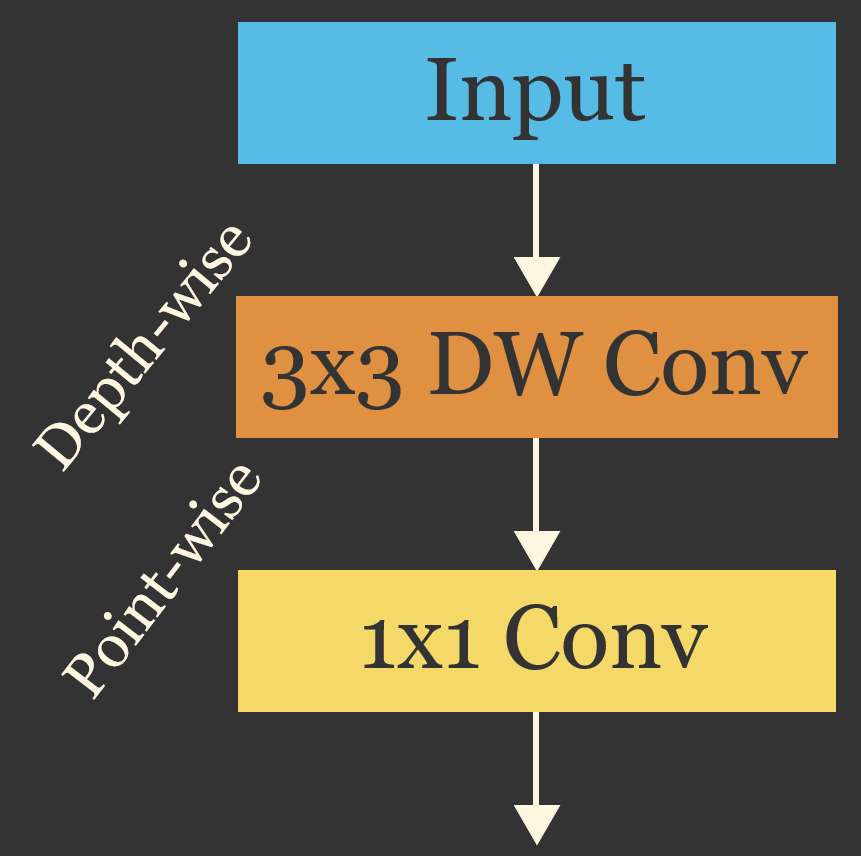
Depthwise separable convolution: A standard 3x3 convolution learns a separate 3x3 kernel for every combination of input and output channel. A depthwise separable convolution splits this into two steps: (1) a depthwise convolution, which applies a single 3x3 kernel to each input channel separately, capturing spatial patterns within each channel, followed by (2) a pointwise 1x1 convolution, which combines information across channels. For a layer with \(C_{in}\) input channels, \(C_{out}\) output channels, and a \(k \times k\) kernel, a standard convolution requires \(k^2 C_{in} C_{out}\) weights while a depthwise separable convolution requires \(k^2 C_{in} + C_{in} C_{out}\) weights. For a 3x3 kernel with 256 input and output channels, this is a reduction from 589,824 to 67,840 weights, or nearly a factor of nine. In PyTorch, a depthwise convolution is implemented by setting the
groupsargument ofnn.Conv2d()equal to the number of input channels. - Inverted residual blocks: In the bottleneck blocks used in ResNet-50 and deeper ResNets, the number of channels is reduced with a 1x1 convolution, a 3x3 convolution is applied, and the number of channels is then increased again. MobileNetV2 inverts this: a 1x1 convolution first expands the number of channels (by a factor of 6 by default), a 3x3 depthwise convolution is applied to the expanded representation, and a 1x1 convolution projects the result back to a small number of channels. When the input and output shapes match, a residual connection adds the block’s input to its output. Since the residual connections link the narrow representations, the memory required to store the intermediate results is reduced.
- Linear bottlenecks: The final 1x1 projection in each block is not followed by an activation function. The authors argued that applying a ReLU to a low-dimensional representation destroys information, so the projection is kept linear. The other layers use ReLU6, a version of ReLU that caps activations at 6, which is more robust when using low-precision computation.
The depthwise separable convolution block described in item 1 is conceptualized in Figure 12.4.
The code below defines a single inverted residual block from scratch to illustrate these components. The groups=hidden argument makes the 3x3 convolution depthwise.
class InvertedResidual(nn.Module):
    def __init__(self, inChn, outChn, stride=1, expand=6):
        super().__init__()
        hidden = inChn * expand
        self.useRes = (stride == 1) and (inChn == outChn)
        self.block = nn.Sequential(
            nn.Conv2d(inChn, hidden, kernel_size=1, bias=False),           # expand
            nn.BatchNorm2d(hidden),
            nn.ReLU6(inplace=True),
            nn.Conv2d(hidden, hidden, kernel_size=3, stride=stride, padding=1,
                      groups=hidden, bias=False),                          # depthwise
            nn.BatchNorm2d(hidden),
            nn.ReLU6(inplace=True),
            nn.Conv2d(hidden, outChn, kernel_size=1, bias=False),          # linear projection
            nn.BatchNorm2d(outChn),
        )

    def forward(self, x):
        return x + self.block(x) if self.useRes else self.block(x)

summary(InvertedResidual(32, 32), (12, 32, 64, 64))
MobileNetV2 is available in torchvision, along with pre-trained ImageNet weights. As with the other architectures, I use the weights argument to load pre-trained weights; weights="DEFAULT" loads the best available weights for the architecture. Comparing the model summary to those for VGGNet-16 and ResNet-34 above, you can see that MobileNetV2 has roughly 3.5 million parameters, compared to roughly 21.8 million for ResNet-34 and 138 million for VGGNet-16.
modelMN = torchvision.models.mobilenet_v2(weights="DEFAULT").to(device)
summary(modelMN, (12, 3, 224, 224))
Similar to ResNet, the torchvision implementation of MobileNetV2 can be adapted to accept a different number of input channels and differentiate a different number of classes. The architecture consists of a features component, which contains the convolutional layers, and a classifier component, which contains a dropout layer followed by a fully connected layer. The first layer of the features component is a 3x3 convolution with a stride of 2, which must be replaced to accept a different number of input channels. The last layer of the classifier component must be replaced to output the desired number of class logits. As with ResNet, the replaced layers are initialized randomly and are trainable even if the rest of the architecture is frozen.
def initialize_mobilenet(nChn, nCls, freeze=False, weights="DEFAULT"):
    model = torchvision.models.mobilenet_v2(weights=weights)
    if freeze:
        for param in model.parameters():
            param.requires_grad = False
    # Replace the first convolution to accept nChn input channels
    model.features[0][0] = nn.Conv2d(nChn, 32, kernel_size=3, stride=2, padding=1, bias=False)
    # Replace the final fully connected layer to output nCls logits
    model.classifier[1] = nn.Linear(model.last_channel, nCls)
    return model

modelMN = initialize_mobilenet(nChn=10, nCls=10, freeze=False).to(device)
summary(modelMN, (12, 10, 64, 64))
The trade-off for this efficiency is that MobileNetV2 is often somewhat less accurate than larger architectures, although the difference depends on the problem and the amount of training data. Since it has fewer parameters, it may also be less prone to overfitting when training data are limited. Other efficient architecture families available in torchvision include MobileNetV3 and EfficientNet, which also uses inverted residual blocks and the Swish activation function discussed in Chapter 7.
12.5 Training torchvision Architectures with Lightning
Any of the architectures discussed in this chapter can be trained using the LitClassifier LightningModule defined in Chapter 10, since it accepts any nn.Module that returns class logits. For example, the code below wraps the modified MobileNetV2 architecture and trains it using the EuroSAT DataLoaders defined in Chapter 11. We will train a modified ResNet-34 architecture using this approach in the next chapter.
import lightning as L
from lightning.pytorch.callbacks import ModelCheckpoint

litMN = LitClassifier(model=initialize_mobilenet(nChn=10, nCls=10), nCls=10, lr=1e-3)

trainer = L.Trainer(max_epochs=50, accelerator="gpu", devices=1, precision="bf16-mixed",
                    default_root_dir="data/output/",
                    callbacks=[ModelCheckpoint(monitor="val_f1", mode="max")])
trainer.fit(litMN, train_dataloaders=trainDL, val_dataloaders=valDL)
12.6 Predict Using a Pretrained Model
Let’s now use a pre-trained network to predict the label for an input image. Here, I will use a picture of my cat Peri. The path to the file is defined and the image is read in using PIL. I then plot the image using imshow() from matplotlib.
imgPth = "data/files/other/peri.jpg"img1 = Image.open(imgPth)plt.imshow(img1)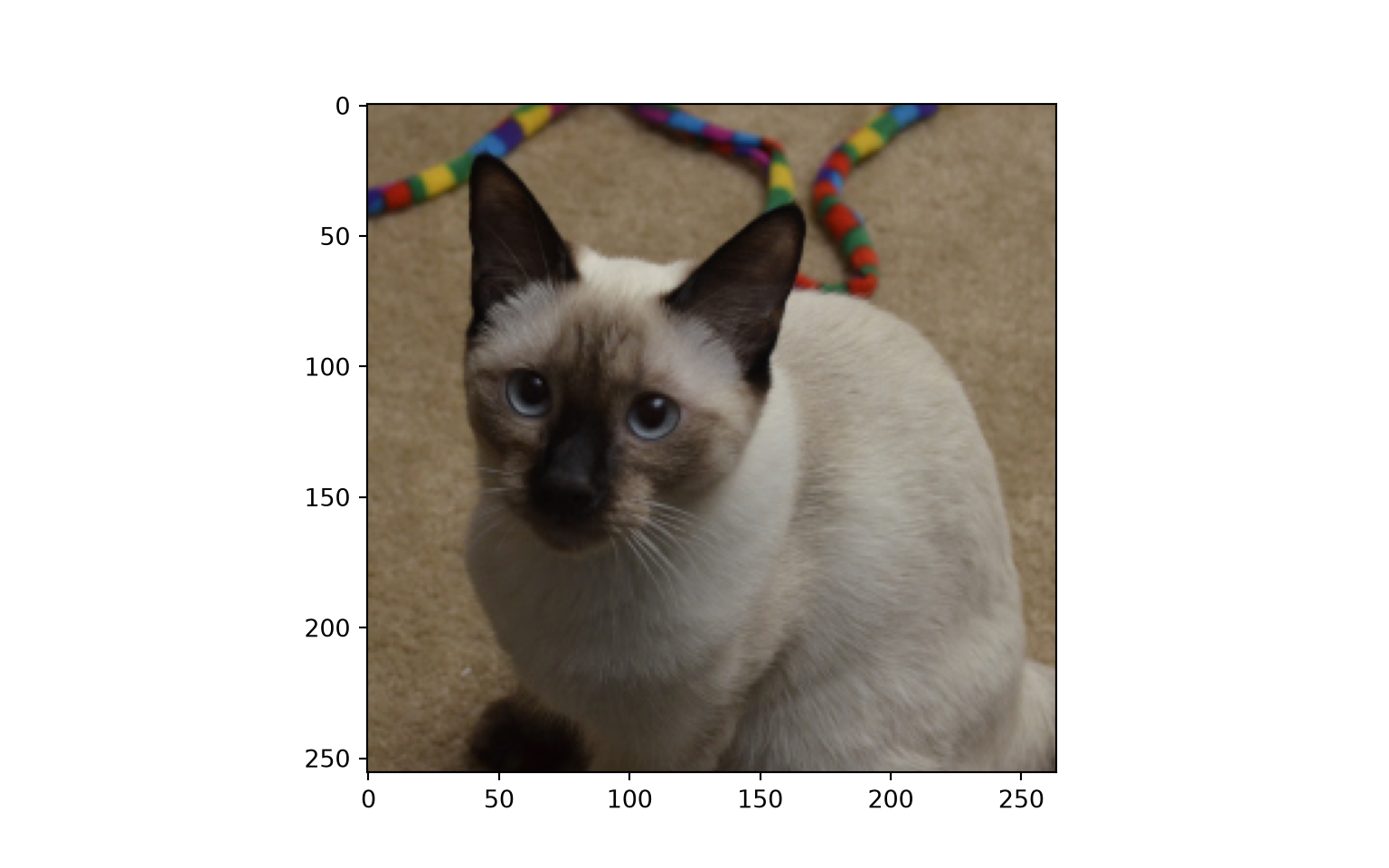
Since I will use a pre-trained model and not make any modifications to the architecture, as I did above, the image will need to be transformed to the anticipated shape. This is accomplished using transforms as define by torchvision. I also normalize the bands relative to the band means and standard deviations of ImageNet, the dataset used to develop the pre-trained weights being loaded. This is generally required when using pre-trained weights.
I then apply the defined transforms to the image, which includes transforming it to a torch tensor. The unsqueeze() function is used to add a dimension at index 0 since the model expects a batch dimension. The image is then moved to the device.
transform = transforms.Compose([
    transforms.Resize(256),
    transforms.CenterCrop(224),
    transforms.ToTensor(),
    transforms.Normalize(mean=[0.485, 0.456, 0.406], std=[0.229, 0.224, 0.225])
    ])
imgT = transform(img1)
imgB = torch.unsqueeze(imgT, 0).to(device)I instantiate an instance of a ResNet-34 model with pre-trained weights and move it to the device.
model = torchvision.models.resnet34(weights="DEFAULT").to(device)The model is also placed in evaluation mode using the eval() method for the model. This is important so that using the model does not impact the computational graph or gradients. I next predict the image using the model.
I read in a mapping of the class codes and associated class labels that was obtained at the commented out link. ImageNet differentiates a total of 1,000 classes. Using the results and this mapping, I then print the class with the highest predicted probability followed by the top 5 classes.
The model predicted that the image was of a “Siamese cat” with a 99.8% probability. This is pretty impressive. The next two highest rankings are two other types of cats followed by “paper towel” and “sleeping bag”.
model.eval()
prediction = model(imgB)
#https://learnopencv.com/pytorch-for-beginners-image-classification-using-pre-trained-models/
with open('data/files/other/imagenet1000_clsidx_to_labels.txt') as f:
classes = [line.strip() for line in f.readlines()]_, index = torch.max(prediction, 1)
percentage = torch.nn.functional.softmax(prediction, dim=1)[0] * 100
print(classes[index[0]], percentage[index[0]].item())284: 'Siamese cat, Siamese', 99.83118438720703_, indices = torch.sort(prediction, descending=True)
[(classes[idx], percentage[idx].item()) for idx in indices[0][:5]][("284: 'Siamese cat, Siamese',", 99.83118438720703), ("287: 'lynx, catamount',", 0.043476611375808716), ("285: 'Egyptian cat',", 0.031856320798397064), ("700: 'paper towel',", 0.006874506827443838), ("797: 'sleeping bag',", 0.006686540320515633)]12.7 Display Feature Maps
The next set of code was obtained from the following Medium post:
https://ravivaishnav20.medium.com/visualizing-feature-maps-using-pytorch-12a48cd1e573
The goal of this code is to generate visualizations of the feature maps. Remember that feature maps represent the learned kernels applied to the input data or prior feature maps from the prior layers. We will specifically make use of the results from the ResNet-34 model applied to the picture of Peri that were obtained above.
This code does the following:
- Extract and store all of the
nn.Conv2d()layers in a list and all of the associated kernel weights in a second list - Apply the kernels to the input image to obtain feature maps and save the outputs and associated names to lists
- Sum across channels
- Generate a plot of learned feature maps
It is interesting to explore the learned feature maps to determine what features of the image are being used to make predictions at the varying levels of the architecture. It is also interesting to see the impact of max pooling on the spatial dimensions of the array.
I encourage you to read the Medium post referenced here for a more detailed discussion of this code.
#https://ravivaishnav20.medium.com/visualizing-feature-maps-using-pytorch-12a48cd1e573
# we will save the conv layer weights in this list
model_weights =[]
#we will save the 49 conv layers in this list
conv_layers = []
# get all the model children as list
model_children = list(model.children())
#counter to keep count of the conv layers
counter = 0
#append all the conv layers and their respective wights to the list
for i in range(len(model_children)):
    if type(model_children[i]) == nn.Conv2d:
        counter+=1
        model_weights.append(model_children[i].weight)
        conv_layers.append(model_children[i])
    elif type(model_children[i]) == nn.Sequential:
        for j in range(len(model_children[i])):
            for child in model_children[i][j].children():
                if type(child) == nn.Conv2d:
                    counter+=1
                    model_weights.append(child.weight)
                    conv_layers.append(child)
print(f"Total convolution layers: {counter}")
Total convolution layers: 33print("conv_layers")conv_layersimage = imgBoutputs = []
names = []
for layer in conv_layers[0:]:
image = layer(image)
outputs.append(image)
names.append(str(layer))
print(len(outputs))33#print feature_maps
for feature_map in outputs:
print(feature_map.shape)torch.Size([1, 64, 112, 112])
torch.Size([1, 64, 112, 112])
torch.Size([1, 64, 112, 112])
torch.Size([1, 64, 112, 112])
torch.Size([1, 64, 112, 112])
torch.Size([1, 64, 112, 112])
torch.Size([1, 64, 112, 112])
torch.Size([1, 128, 56, 56])
torch.Size([1, 128, 56, 56])
torch.Size([1, 128, 56, 56])
torch.Size([1, 128, 56, 56])
torch.Size([1, 128, 56, 56])
torch.Size([1, 128, 56, 56])
torch.Size([1, 128, 56, 56])
torch.Size([1, 128, 56, 56])
torch.Size([1, 256, 28, 28])
torch.Size([1, 256, 28, 28])
torch.Size([1, 256, 28, 28])
torch.Size([1, 256, 28, 28])
torch.Size([1, 256, 28, 28])
torch.Size([1, 256, 28, 28])
torch.Size([1, 256, 28, 28])
torch.Size([1, 256, 28, 28])
torch.Size([1, 256, 28, 28])
torch.Size([1, 256, 28, 28])
torch.Size([1, 256, 28, 28])
torch.Size([1, 256, 28, 28])
torch.Size([1, 512, 14, 14])
torch.Size([1, 512, 14, 14])
torch.Size([1, 512, 14, 14])
torch.Size([1, 512, 14, 14])
torch.Size([1, 512, 14, 14])
torch.Size([1, 512, 14, 14])processed = []
for feature_map in outputs:
feature_map = feature_map.squeeze(0)
gray_scale = torch.sum(feature_map,0)
gray_scale = gray_scale / feature_map.shape[0]
processed.append(gray_scale.data.cpu().numpy())
for fm in processed:
print(fm.shape)(112, 112)
(112, 112)
(112, 112)
(112, 112)
(112, 112)
(112, 112)
(112, 112)
(56, 56)
(56, 56)
(56, 56)
(56, 56)
(56, 56)
(56, 56)
(56, 56)
(56, 56)
(28, 28)
(28, 28)
(28, 28)
(28, 28)
(28, 28)
(28, 28)
(28, 28)
(28, 28)
(28, 28)
(28, 28)
(28, 28)
(28, 28)
(14, 14)
(14, 14)
(14, 14)
(14, 14)
(14, 14)
(14, 14)nCols = 6
nRows = int(np.ceil(len(processed) / nCols))
fig, axs = plt.subplots(nRows, nCols, figsize=(nCols * 2, nRows * 2.2))
for i, ax in enumerate(axs.flatten()):
ax.axis("off")
if i < len(processed):
ax.imshow(processed[i])
ax.set_title(f"{i + 1}: {names[i].split('(')[0]}", fontsize=9)
plt.tight_layout()
plt.show()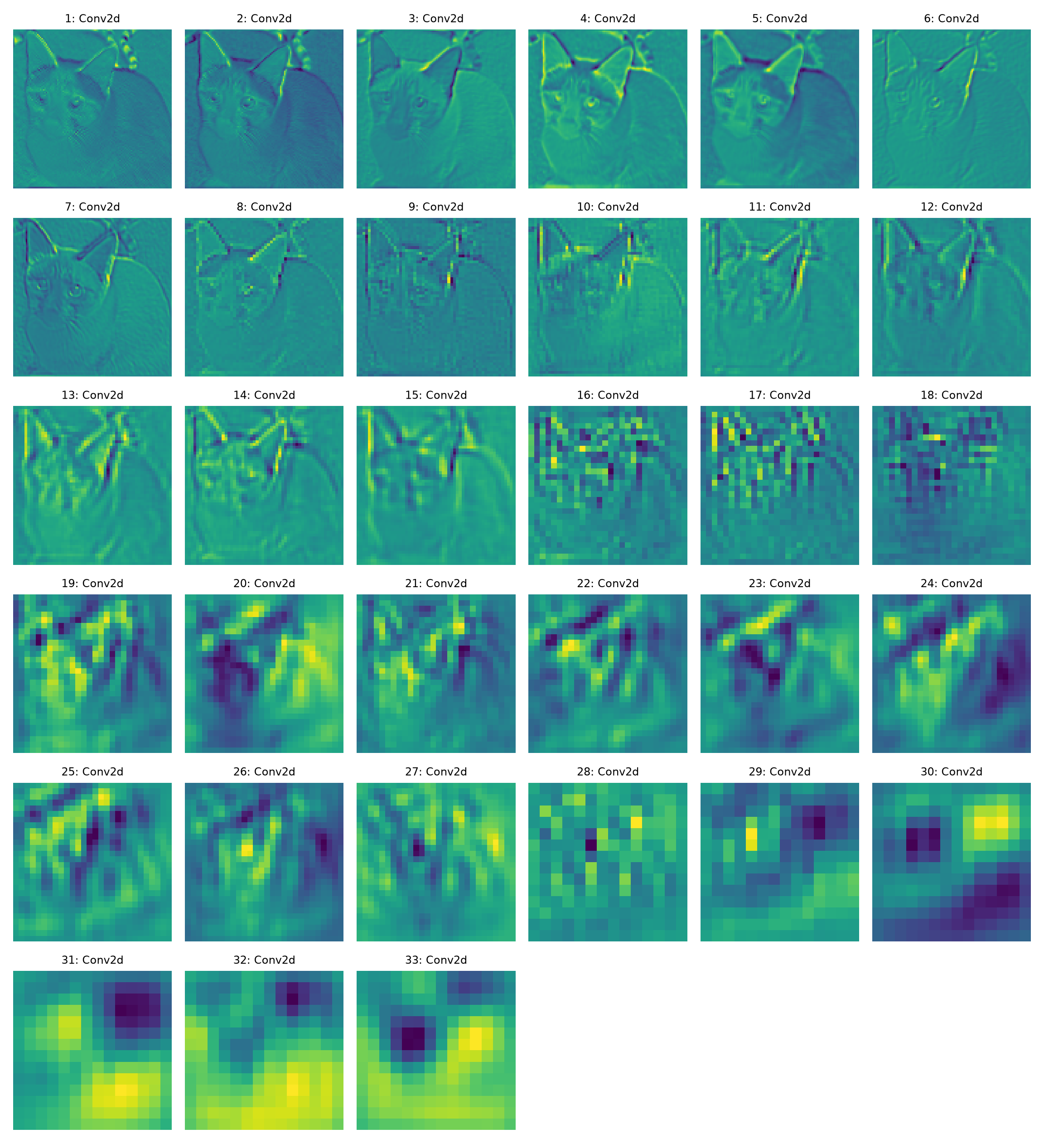
The plot shows the channel-averaged feature map generated by each convolutional layer, in order. The early feature maps retain the detail of the input image, while the feature maps from deeper layers are coarser due to the reduction in spatial dimensions.
12.8 Concluding Remarks
We are now ready to move on to the last chapter focused on using CNNs for scene labeling tasks. In that chapter, we will combine what was discussed and demonstrated in the prior CNN chapters to train a scene classification model using transfer learning, a modified ResNet-34 architecture, and PyTorch Lightning, including using different learning rates for different components of the architecture.
12.9 Questions
- Explain how a depthwise separable convolution reduces the number of trainable parameters relative to a standard convolution. How many weights are required for a standard 3x3 convolution and a depthwise separable 3x3 convolution with 64 input and 128 output channels (ignoring biases)?
- Compare the VGGNet-16, ResNet-34, and MobileNetV2 architectures as implemented in torchvision in regard to the number of trainable parameters. Explain the purpose of the inverted residual blocks and linear bottlenecks used in MobileNetV2.
- Explain what it means to freeze a model’s parameters and how this is accomplished using the
requires_gradproperty. What are the benefits of freezing parameters? - Why do many pre-trained CNN architectures expect a specific input image size? How does the use of
nn.AdaptiveAvgPool2d()in the ResNet architecture make it easier to generalize to other input sizes? - Explain the modifications required to adapt a pre-trained ResNet architecture to accept a different number of input channels and to differentiate a different number of classes.
- Why must the first convolutional layer, the associated batch normalization layer, and the final fully connected layer be replaced after the model’s parameters are frozen?
- When using a model pre-trained on ImageNet to predict a new image, why must the image be resized and normalized using the ImageNet band means and standard deviations?
- What is a feature map? What can be learned by visualizing feature maps generated at different depths within a CNN architecture?